








Most sourcing problems do not show up during negotiation. They show up in a warehouse three months later, when a pallet of finished lotion arrives with separated emulsion, mismatched cap colours, or fill weights that drift 4% below the label claim. By that point the money is spent, the retail launch date is fixed, and your options are bad ones.
Quality control is the part of the relationship that separates a supplier from a partner. Yet it is also the part most first-time buyers never inspect, because it happens inside the factory where they cannot see it. This guide opens that black box. It walks through what a competent body lotion manufacturer actually checks, when those checks happen, what documentation you should demand, and how to run your own verification before you release final payment.
The Three Layers of Quality Control
Manufacturing QC is not a single event at the end of the line. It operates in three layers, and a weakness in any one of them will eventually reach your customer.
Incoming quality control (IQC) governs raw materials and packaging components before they ever enter production. In-process quality control (IPQC) monitors the batch while it is being made and filled. Outgoing quality control (OQC), sometimes called final random inspection, verifies the finished, packed goods before they leave the building.
Ask a factory to describe all three. If the answer collapses into “we check everything at the end,” you are talking to a filler, not a manufacturer. End-of-line inspection can only sort good units from bad ones. It cannot recover a batch whose emulsion broke because a fatty alcohol arrived off-spec.
Layer One: Incoming Material Verification
Every raw material shipment should arrive with a Certificate of Analysis (CoA) from the supplier, and the factory’s own lab should verify a subset of those claims rather than accepting the paperwork at face value.
For a typical lotion, the meaningful incoming checks are:
- Identity and appearance — colour, odour, and physical state against a retained reference standard.
- Key physical parameters — acid value and saponification value for lipids, viscosity for polymer thickeners, moisture content for powdered actives.
- Microbiological screening — total aerobic count on water-phase materials and botanical extracts, which are the usual contamination entry points.
- Packaging dimensional checks — neck finish, thread pitch, wall thickness, and pump dip-tube length. A pump that is two millimetres too short will strand product in the bottle and generate complaints you cannot fix later.
Ask for the retention policy too. Good factories keep a sealed retain sample of every raw material lot and every finished batch for at least the shelf life plus one year. When a complaint arrives eighteen months after shipment, retains are the only way to determine whether the problem originated in the formula, the fill, or the field.
Layer Two: In-Process Control During the Batch
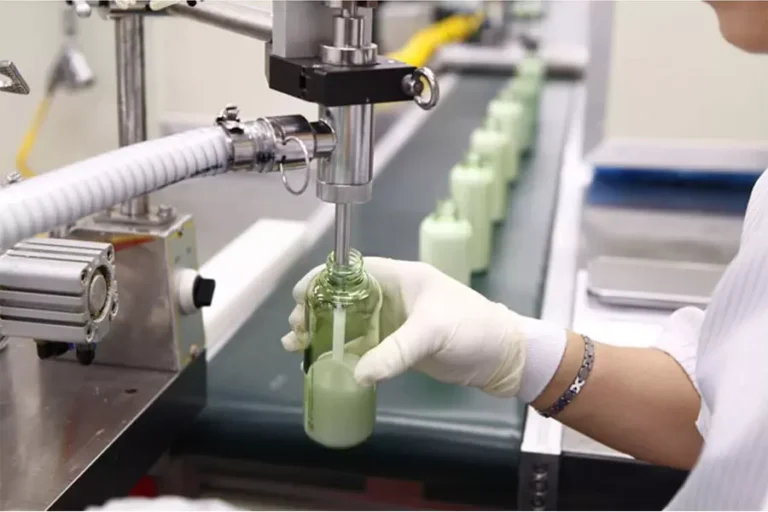
This is where a serious operation reveals itself. During compounding and filling, the QC technician should be pulling samples at defined checkpoints and recording results on a batch manufacturing record (BMR) that is signed in real time.
The checkpoints that matter for lotion:
- Phase temperatures before emulsification. Oil and water phases that are more than a few degrees apart when combined produce coarse, unstable droplets.
- Homogenisation time and speed, logged against the master formula. Over-shearing thins the product; under-shearing leaves it grainy.
- Bulk pH after cool-down. Most lotions sit between 5.0 and 6.0. Drift outside the specified window compromises both skin feel and preservative efficacy.
- Viscosity at a stated temperature and spindle speed. Viscosity read at 25°C means nothing if your spec was written at 20°C.
- Fill weight checks at defined intervals — commonly every fifteen to thirty minutes, plus after every line stoppage or changeover.
- Torque testing on caps. Under-torqued closures leak in transit; over-torqued ones crack or become impossible for consumers to open.
Request a blank copy of the BMR template before you place an order. It tells you more about a factory’s discipline than any brochure. If the template has no signature fields, no in-process checkpoints, and no deviation section, the quality system exists on paper only. The same logic applies when you are still shortlisting suppliers — our body lotion manufacturer audit checklist covers the specific questions that surface these gaps before you commit.
Understanding Fill Weight and Overfill
Fill weight deserves its own discussion because it is where cost and compliance collide.
Regulators in most markets apply an average-content rule: the mean of a sampled batch must meet or exceed the declared quantity, and individual units may fall below only within defined tolerance bands. In the United States, net contents are governed by the Fair Packaging and Labeling Act; in the EU, the “e-mark” system sets tolerable negative errors by pack size.
Factories manage this by targeting a small deliberate overfill — usually 0.5% to 2% depending on line accuracy and product viscosity. Thicker lotions and pumped fills need more headroom than thin lotions in wide-mouth jars.
Two things to confirm: that the target overfill is written into your specification rather than left to the operator, and that fill checks are recorded, not merely performed. A line that runs 3% overfill without telling you is quietly giving away product you paid for. A line that runs 1% underfill is exposing you to a regulatory problem with your name on the label, not theirs.
Layer Three: Finished Goods and AQL Sampling
Final inspection uses statistical sampling rather than 100% examination. The standard framework is ISO 2859-1, widely known by its older military designation AQL (Acceptable Quality Limit).
Here is how it works in practice. You agree a lot size, an inspection level (General Level II is the norm), and AQL thresholds for three defect classes:
- Critical defects — anything unsafe or illegal: contamination, missing warning text, incorrect ingredient declaration. AQL 0. One is too many.
- Major defects — faults a customer would reject: leaking closures, illegible batch codes, badly misaligned labels, off-shade product. Typically AQL 2.5.
- Minor defects — cosmetic imperfections a customer would likely accept: faint scuffing, slight label skew within tolerance. Typically AQL 4.0.
For a 5,000-unit lot at General Level II, the sample size is 200 units. At AQL 2.5 for majors, the lot is accepted at 10 defects and rejected at 11. Those numbers should appear in your purchase order, not be improvised after the goods are packed.
Two practical additions. First, specify that inspection happens when the batch is at least 80% packed and cartoned, so the sample reflects shipping condition rather than loose units on a bench. Second, define who pays for a re-inspection after a failed lot. Standard practice is that the supplier absorbs the cost of the second visit.
Stability and Compatibility: The Tests That Protect Your Shelf Life
Stability testing is not a QC step on a single batch — it is qualification work done once on the formula-package combination, and it is the evidence behind your expiry date.
A standard protocol runs samples at 4°C, 25°C, 40°C, and 45°C for twelve weeks, plus freeze-thaw cycling and a light exposure arm. Three months at 40°C is broadly treated as a proxy for two years at ambient. At each interval the lab checks appearance, odour, pH, viscosity, and centrifuge stability.
Packaging compatibility runs in parallel and is routinely neglected. Fragrance components migrate into polypropylene. Certain actives interact with metallised caps. Airless pumps can fail with high-viscosity formulas. The test is simple: fill the actual production packaging, store it under the same conditions, and check for weight loss, panelling, discolouration, and pump function.
Preservative efficacy testing (PET, or the “challenge test” under ISO 11930) deliberately inoculates the product with five reference organisms and measures log reduction over 28 days. Any water-containing lotion needs a passing PET on the final formula in the final pack. Insist on seeing it. If you are still deciding between a stock base and a bespoke formula, the trade-offs are covered in our comparison of custom formulation versus stock formulas — a stock base will usually already have this data on file, which saves both time and money.
What to Ask For Before You Release Final Payment
A complete finished-goods documentation package should include the batch manufacturing record with signatures, the finished-product CoA (appearance, pH, viscosity, specific gravity, fill weight, micro results), microbiological test results against USP 61/62 or ISO 21149 limits, the inspection report with photographs and defect classification, and retained sample confirmation.
Structure your payment terms so this package is a condition of the final tranche. A common arrangement is 30% deposit, 40% on completion of production, and 30% against inspection pass and document delivery. Paying the full balance before inspection removes the only leverage you have.
Third-Party Inspection: When It Is Worth the Cost
Independent inspection from firms such as SGS, Bureau Veritas, Intertek, or QIMA typically costs USD 250–350 per man-day in China. For a first order, an order above roughly USD 20,000, or any launch tied to a fixed retail window, that is inexpensive insurance.
Give the inspector a written checklist rather than a generic brief. Specify the AQL levels, the artwork version to verify against, the fill weight tolerance, the carton drop test requirement, and the barcode scan check. An inspector without a defined standard will report only what is obviously broken.
Once a supplier has delivered several consistent batches, many buyers step down to inspecting every third shipment. That is a reasonable evolution — but keep it a documented decision, not a habit of drift.
Building QC Into the Relationship
The most effective quality systems are contractual, not aspirational. Attach a product specification sheet to your purchase order that defines every acceptance parameter with a numeric range and a test method. “Pleasant fragrance” is unenforceable. “Fragrance matches approved standard PW-2026-04, evaluated by trained panel at 25°C” is.
Agree a deviation procedure as well. Batches occasionally drift — viscosity comes in 8% low, or a shade sits slightly outside tolerance. What matters is whether the factory notifies you and requests a concession, or ships it and hopes. Written deviation reporting, with your explicit approval required before release, is the single clause that most reliably prevents unpleasant surprises.
None of this requires an in-house technical team. It requires knowing which questions to ask, writing the answers into the contract, and verifying before the money leaves. Suppliers who take quality seriously welcome that scrutiny, because it distinguishes them from competitors who compete only on price. If you are at the earlier stage of evaluating partners, start with our guide on how to choose a body lotion manufacturer in China, then return to this framework once you have a shortlist worth auditing.
Qianlan applies the same in-process and pre-shipment framework across its contract manufacturing for body lotion, and makes batch records available to customers on request.