








Two Paths Into the Same Bottle
Every body lotion on a shelf started as either a stock formula (a ready-made base the factory already produces) or a custom formulation (a recipe developed specifically for one brand). For founders, the choice is rarely about which is “better” — it is about matching the development path to your budget, timeline, and brand ambition. A capable body lotion manufacturer will offer both, and the right answer usually changes as your business grows.
What a Stock Formula Is
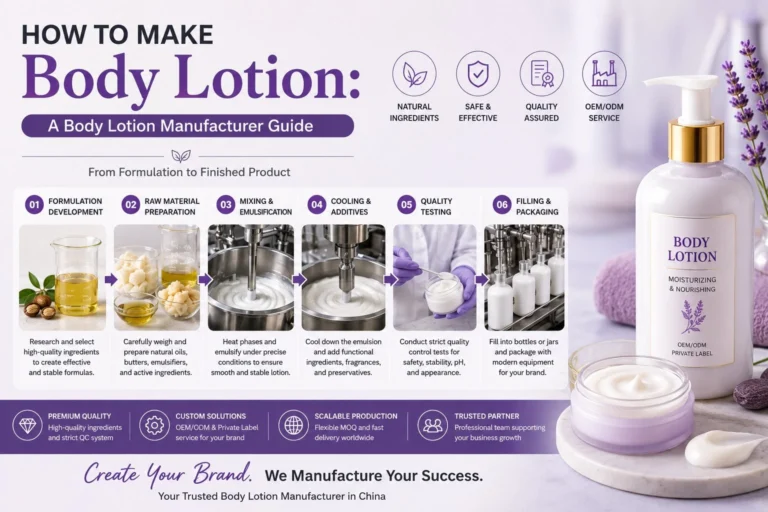
A stock formula is a finished, stability-tested emulsion the factory has already validated: a daily moisturizer, a urea foot cream, a brightening lotion with niacinamide, and so on. You select the base, pick a fragrance (or fragrance-free), choose packaging, and apply your label. Because the chemistry is proven, there is no development fee and no repeat stability testing, so you can launch in roughly 45 to 60 days. Stock bases are the engine behind most private-label programs and the fastest way to get a credible product to market.
What a Custom Formulation Is
A custom formulation starts from a brief: a specific texture, a unique active blend (for example 5% urea plus 2% salicylic acid for rough skin), a proprietary scent, or a claim your competitors cannot match. The factory’s R&D team builds the formula, adjusts it across several rounds, and runs microbial and accelerated stability testing before production. Development typically takes 8 to 16 weeks and may carry a project fee of USD 500 to USD 3,000 depending on complexity, though many factories waive or amortize this against a volume commitment.
Comparison at a Glance
| Factor | Stock Formula | Custom Formulation |
|---|---|---|
| Development time | None (ready to fill) | 8–16 weeks |
| Development cost | Usually $0 | $500–$3,000+ |
| Lead time to ship | 45–60 days | 75–120 days |
| Differentiation | Limited (base is shared) | High (unique to you) |
| Regulatory risk | Low (pre-validated) | Managed via testing |
| Best for | Fast launch, testing | Defensible hero SKU |
The Hidden Cost of “Custom”
Custom does not mean infinitely flexible. Emulsion chemistry has constraints: some actives are incompatible, high oil loads slow absorption, and certain natural claims require preservative systems that affect feel. A realistic custom project involves 2 to 4 sampling rounds, each taking 1 to 2 weeks plus shipping. Budget for that iteration time, and do not expect the first sample to be final. The brands that succeed treat formulation as a collaboration with their body lotion manufacturer in China rather than a one-shot order.
When Stock Makes More Sense
- You are validating demand. Spend on marketing, not chemistry, until you know the product sells.
- You need speed. A 45-day stock launch beats a 4-month custom build when a seasonal window is closing.
- Your margin is tight. With no development fee, stock formulas protect early cash flow.
- The base already fits. If an existing shea or oat base matches your positioning, customizing it may add cost without adding value.
When Custom Pays Off
- You have a defensible claim. A unique active stack becomes a moat competitors cannot copy from a catalog.
- You are building a hero SKU. Your flagship should feel proprietary; a shared base undercuts that story.
- You have sales traction. Once a product sells consistently, the per-unit saving from differentiation exceeds the dev cost.
- You need a specific regulation fit. EU or clean-beauty retailers may require formulations a stock base cannot meet.
A Hybrid That Works for Many Brands
You do not have to pick one lane forever. A common, capital-efficient path is: launch on a stock or lightly adjusted base, prove the market, then commission a custom version of your bestseller. This keeps risk low early and builds defensibility later. It also means your private label vs white label decision and your formulation decision stay aligned — private label usually sits on a stock or lightly tuned base, while true OEM sits on custom work.
How to Brief the R&D Team
A strong custom brief includes: target skin benefit, desired viscosity and absorption speed, must-include or must-exclude ingredients (e.g., no parabens, vegan), fragrance direction, target cost of goods, and the retail claim you want to make. The more precise the brief, the fewer the sampling rounds. Ask upfront which tests the factory runs (microbial limit, challenge, accelerated stability at 45°C) and request the report before you scale.
MOQ Interacts With the Choice
Custom formulas often carry higher minimums because the factory may need to buy specialty raw materials in supplier minimum pack sizes. Expect a custom MOQ of 3,000 to 5,000 units versus 1,000 to 3,000 for stock. A solid understanding of MOQ in OEM cosmetics lets you plan inventory and cash flow before signing.
Making the Call
If you are early, cash-conscious, or racing a launch window, start with a stock or lightly adjusted formula and ship. If you are building a brand with a unique promise and proven demand, invest in custom formulation — the defensibility is worth the lead time and fee. Either way, choose a partner whose R&D transparency you trust.
Reading a Formula Sheet (INCI)
Every cosmetic must list ingredients by INCI name in descending concentration. A stock base sheet lets you check for allergens, banned substances in your market, and whether the “natural” claim holds up. Learn to read the first five ingredients — they make up most of the formula. Water (aqua) is usually first; the next emollients and humectants define the feel. If a factory will not share the full INCI before contract, treat it as a serious red flag.
Stability and Preservation Basics
Body lotion is a water-based emulsion, which means microbes love it. Preservation is not optional. Stock formulas arrive with a validated preservative system and challenge-test data; custom formulas must be re-tested because each active changes the microbial landscape. Ask for the microbial challenge test (typically 28 days) and accelerated stability at 45°C for 1–3 months. Skipping these is how brands end up with separated or contaminated product and a recall.
A Simple Cost-per-mL Comparison
| Path | Dev cost | Unit cost (200 ml) | True cost at 3,000 units |
|---|---|---|---|
| Stock base | $0 | $1.60 | $4,800 + freight |
| Light private label | $0–300 | $1.90 | $5,700 + freight |
| Custom OEM | $1,500 | $2.20 | $8,100 (incl. dev) |
The table shows custom is not “better” — it is a different bet. At low volume the dev fee inflates true cost; at high volume the differentiation pays back.
Sourcing Actives Without Surprises
Custom projects often specify trending actives (centella, bakuchiol, peptides). Confirm availability and supplier lead time before you brief — some specialty raws have 4–8 week lead times that silently push your launch. A good R&D team will propose in-stock alternatives with similar benefits to keep your timeline intact.
Common Startup Objections, Answered
- “Stock feels generic.” A tuned stock base with your scent and pack is far from generic and ships months sooner.
- “Custom is more premium.” Only if the formula delivers a perceptible difference the customer notices.
- “I’ll just copy a competitor.” Reverse-engineering a feel is slow and legally risky; brief from benefits instead.
Planning the Move From Stock to Custom
A clean sequence: launch on stock, capture reviews and repeat-purchase data for 6–12 months, then commission a custom version of your top SKU using proven demand as justification for the higher MOQ. This stages risk and keeps cash free for growth marketing.
Signals a Factory Can Truly Do Custom
Not every “custom” claim is real. Strong signals include an in-house lab with analytical equipment (pH meters, viscometers, centrifuges), a documented stage-gate development process, and R&D staff who ask technical questions about your brief rather than just yes-ing it. Weak signals: no stability data on file, inability to explain preservative choice, or a quote that appears before they have seen your ingredient list. The former indicates a partner who will protect your product; the latter indicates a trader guessing.
Your Sample Evaluation Checklist
- Appearance: uniform, no separation, no granules after 24 hours at room temperature.
- Feel: absorbs within the time you specified; no greasy film unless intended.
- Scent: matches the brief and does not turn off-notes after a week.
- Stability: request the 45°C and freeze-thaw results, not just a promise.
- Fill: actual weight within ±2% of label claim.
Score each sample against this list so your decision is evidence-based, not a gut call made under launch pressure.
Not sure which path fits your brand? Qianlan is a GMP-certified body lotion manufacturer offering both ready stock bases and full custom R&D. Contact our team for a free formulation consultation and quotation.