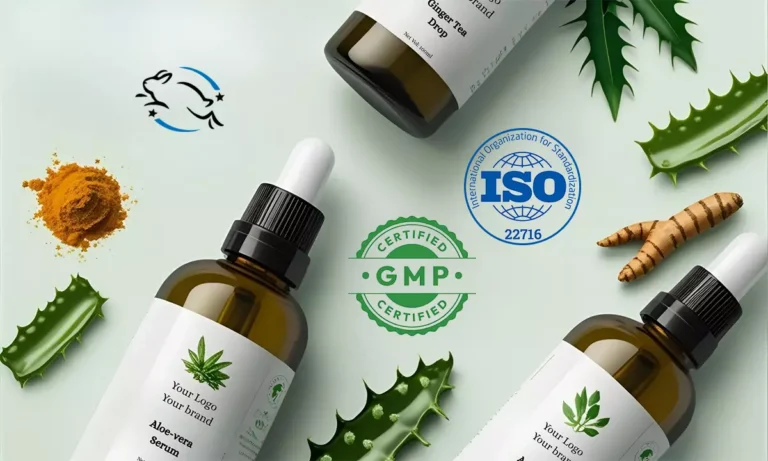









ISO 22716 is the global Good Manufacturing Practice (GMP) standard written specifically for the cosmetics industry. If you are sourcing private label or OEM body lotion, it is the single certification that tells you a factory runs a documented, repeatable, hygienic process rather than a workshop that hopes for the best. This guide explains what the standard actually covers, why it matters for your brand’s risk profile, and how to verify a supplier’s claim before you sign.
What ISO 22716 Actually Covers
Unlike a product safety test, ISO 22716 is a process standard. It specifies requirements across the full lifecycle of cosmetic production, and a credible body lotion manufacturer should be able to show evidence for every clause below.
- Personnel — hygiene training, health checks, and defined responsibilities so human error is controlled rather than hidden.
- Premises and equipment — layout that prevents cross-contamination, controlled air and water quality, and calibrated, cleanable machinery.
- Raw material and packaging control — identity, purity, and supplier qualification, with incoming inspection records for every lot.
- Production and filling — validated batch records, in-process controls, and traceability from lot number to finished goods.
- Complaints, recalls, and CAPA — a documented system to investigate deviations and prevent recurrence.
In short, it answers one question for a buyer: can this factory prove, on paper and in practice, that every batch is made the same way under controlled conditions? That proof is what protects your brand when something goes wrong downstream.
Why It Matters for a Body Lotion Brand
Body lotion is a leave-on product applied to large areas of skin, often by families with children and sensitive individuals. The risks of a non-GMP operation — microbial contamination, inconsistent preservative efficacy, foreign matter, mislabeled allergens — are reputational and, in worst cases, regulatory. Three concrete benefits stand out.
1. Batch-to-batch consistency
A GMP site runs validated processes, so the lotion you approve in sampling performs identically in lot 50. That protects your review scores and repeat-purchase rate, which are the engine of any Amazon or retail business.
2. Buyer and retailer confidence
US distributors, Amazon, and specialty retailers increasingly ask for GMP or ISO 22716 evidence during onboarding. A certificate shortens due diligence and unlocks larger accounts that would otherwise pass you over.
3. Cleaner regulatory path
ISO 22716 dovetails with FDA expectations under the Modernization of Cosmetics Regulation Act (MoCRA). Pair it with our FDA compliance guide for skincare brands to close the loop on US market entry and reduce the chance of a registration hold.
ISO 22716 vs a Real GMP Audit
A certificate on a wall is not the same as a living system. Before you commit, run the supplier through a proper body lotion manufacturer audit checklist: request the scope and issuing body of the certificate, ask for a recent surveillance audit report, and confirm the certified site is the one actually filling your product — not a sister facility across town.
The Cost of Non-Compliance
The price of skipping GMP verification is rarely a small one. A single contaminated or off-spec batch can trigger a recall, destroy months of review history, and invite FDA or platform action. For a young brand, that is often an existential event. GMP is not bureaucracy; it is inexpensive insurance against the one failure you cannot absorb.
How to Verify a Supplier’s Claim
- Ask for the certificate number and accrediting body (an ISO 17021-approved registrar, not a self-issued document).
- Confirm scope covers cosmetics manufacturing at the exact site and address on your contract.
- Request a sample batch record (anonymized) to see traceability in action.
- Check the certificate validity dates and any suspension or scope-limitation notes.
- If possible, commission a third-party inspection during a live filling run before your first production order.
ISO 22716 and Your Liability Insurance
Many product-liability insurers now ask for GMP evidence when underwriting cosmetics brands, and some offer lower premiums for documented quality systems. The certificate therefore pays for itself twice: it reduces the chance of a defect and it lowers the cost of covering the risk that remains.
Where Certifications Intersect
ISO 22716 is the manufacturing baseline, but brands with a values or clean-beauty positioning often layer additional proof. Our cruelty-free and vegan certification guide explains how Leaping Bunny, PETA, and vegan claims complement — but do not replace — a GMP foundation. You need the process control first; the badges come after, and they mean more when they sit on top of a real system.
Common Misconceptions
- “ISO 22716 means the product is safe.” It means the process is controlled; safety still depends on formula, preservative system, and challenge testing.
- “A certificate equals a clean audit.” Certificates expire and scope varies; verify, don’t assume.
- “Only big brands need it.” Small brands are most exposed to a single bad batch; GMP is risk insurance you cannot skip.
Documentation You Should Receive
A genuine ISO 22716 operation hands you a documentation package, not just a PDF certificate. Expect a valid certificate with scope and accreditation body, a quality manual summary, standard operating procedures for hygiene and production, batch production records templates, incoming material inspection logs, and a complaints and recalls procedure. This paperwork is what your US distributor, Amazon category manager, or insurer will actually ask for during diligence, so request it up front rather than after a deal is signed.
ISO 22716 and Exports to the US
ISO 22716 is globally recognized but not a substitute for local registration. In the United States, MoCRA requires facility registration, product listing, and adherence to good manufacturing practice; the FDA’s GMP expectations align closely with ISO 22716, so a certified site is already most of the way there. The remaining work is US-specific labeling, ingredient labeling under INCI, and responsible-person documentation. Treating the certificate as one input to a broader compliance plan keeps you export-ready.
When a Certificate Is Not Enough
For high-risk claims — such as products aimed at eczema-prone or infant skin — layer challenge testing, stability data, and a preservative efficacy test on top of GMP. A process certificate does not by itself prove a specific formula is safe for a vulnerable user; pair the system evidence with product-specific testing and you remove the largest source of launch risk.
Clauses You Can Audit Yourself
You do not need to be a chemist to spot a weak system. During a site visit or a video walkthrough, check a few high-signal clauses: are incoming raw materials quarantined and released only after testing? Are batch records filled in at the time of production, not back-dated? Is there a dedicated, cleaned area separating filling from raw material handling? Are staff in the filling zone wearing controlled garments and following hand-hygiene protocol? A site that hesitates on any of these is telling you the certificate is ahead of the practice.
Training and Hygiene Programs
ISO 22716 puts unusual weight on people, because most cosmetic defects trace back to human error. A credible site runs documented hygiene and GMP training for every operator, keeps health records, and restricts personnel from production when ill. Ask to see the training matrix; if the factory cannot show who was trained when, the process discipline is cosmetic on paper only.
How ISO 22716 Reduces Returns and Chargebacks
Returns on body lotion are rarely about scent preference; they are about defects — leakage, separation, contamination, or allergic reactions from mislabeled ingredients. A controlled process attacks each: validated filling prevents under-fill and leakage, stability programs prevent separation, microbiology controls prevent contamination, and documented allergen labeling prevents compliance chargebacks. For a brand, that means fewer one-star reviews and lower reverse-logistics cost, which is where GMP quietly pays for itself.
Partner with a certified base. Qianlan operates as a GMP-certified body lotion manufacturer under ISO 22716, with full batch records, incoming material qualification, and the documentation US buyers expect. Contact our team to review our certificate scope and build your private label line on a verified quality system.