








Launching a body lotion brand on Amazon looks easy until your first shipment sits in a fulfillment center while your PPC burns cash on a listing that does not convert. Amazon rewards differentiated, compliant, well-listed products — and punishes me-too private label with thin margins. This playbook covers the sourcing and launch steps that actually move a body lotion from concept to page-one consideration.
Step 1: Validate Demand Before You Source
Do not brief a factory on a hunch. Start with keyword and category research so you know there is a buyer before you spend on inventory.
- Search volume for terms like “body lotion for dry skin,” “fragrance free body lotion,” and “body butter.” Aim for a primary term with steady 10k+ monthly searches and attainable competition.
- Review mining on the top 10 listings to find unmet complaints — greasy feel, weak scent, pump failure, packaging leaks. Each complaint is a formulation or packaging brief you can exploit.
- Price band analysis — note the $12 to $25 sweet spot for mass-premium and where the review leaders cluster, then decide where you can win.
Step 2: Source a Differentiated Formula
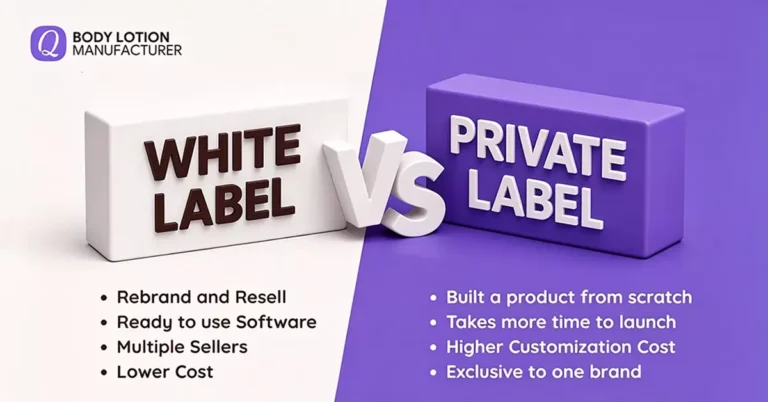
Amazon is saturated with identical aloe-and-glycerin lotions. Win by differentiating at the formula or use-case level: a fast-absorbing gel-lotion, a fragrance-free sensitive option, or a clinically positioned ceramide formula. If you are early stage, our benefits of private label body lotion for startups explains how to get to market fast, and our private label versus white label comparison helps you choose the right control level over the formula and brand.
Step 3: Lock a Compliant, Conversion-Focused Listing
Compliance and conversion are the same project on Amazon. Your detail page must satisfy both the algorithm and the FDA.
- Title and bullets lead with the benefit and use-case, not vague “nourishing” claims that blend into the category.
- Claims substantiation — avoid drug claims like “treats eczema” that trigger listing removal; keep cosmetic structure and appearance claims defensible with data.
- Images — show texture, the pump in hand, and the ingredient story; A+ content reliably lifts conversion by 3 to 10 percent.
- Compliance docs — keep ingredient labeling, MoCRA registration, and GMP evidence ready for account and category checks.
Step 4: Plan Inventory Around Lead Times
The classic Amazon killer is stockout during your ramp. A typical China-to-US private label cycle is: formulation and sampling 2 to 4 weeks, packaging procurement 2 to 3 weeks, production and QC 2 to 3 weeks, ocean freight 25 to 40 days, and FBA inbound 1 to 2 weeks. That is 10 to 14 weeks door to door. Pre-order at least one re-order cycle ahead, and keep a 30 to 45 day safety stock. Choosing the right partner shortens this: our guide on how to choose a body lotion manufacturer in China covers lead-time and communication red flags that cause delays.
Step 5: Budget the Launch Realistically
A modest Amazon launch for a single lotion ASIN commonly requires $4,000 to $10,000 in inventory, $1,500 to $3,000 in listing photography and A+ content, and $2,000 to $5,000 in initial PPC before organic rank settles. Founders who under-budget the ad phase abandon the product right before it would have turned profitable. Plan for at least 90 days of sustained spend.
Step 6: Launch With a Margin-Aware PPC Plan
- Open with exact-match keywords on your hero term; cap ACoS at a contribution-positive threshold.
- Layer auto campaigns to harvest long-tail terms after two weeks of data.
- Use a 15 to 20 percent coupon at launch to lift click-through and conversion velocity.
- Shift budget to the three converting ASINs; kill losers weekly.
- Transition winners to lower-bid exact and broad to protect margin as rank stabilizes.
Brand Registry and Trademark
Before you invest in ranking, file your trademark and enroll in Amazon Brand Registry. It unlocks A+ content, brand analytics, and vital protection against hijackers who clone a winning listing. The trademark lead time (often 8 to 12 months via TEAS, faster via IP Accelerator) should run in parallel with your sourcing, not after.
Post-Launch: Defend the Listing
Once ranked, protect it. Monitor reviews daily in the first 90 days, respond to negatives with real fixes — a leaky pump is a manufacturing issue, not a review problem — and refresh images seasonally. A 4.4-star lotion with 300 reviews outsells a 4.7-star newcomer with 12; velocity and proof beat perfection, so keep the momentum going.
A Sourcing Brief Template
Before contacting factories, write a one-page brief so quotes are comparable. Include target retail price, target COGS ceiling, desired texture and key claims, forbidden ingredients (e.g., parabens, sulfates), volume and re-order cadence, and packaging constraints. Sending the same brief to three to five suppliers yields apples-to-apples pricing and exposes who asks smart follow-up questions — a strong signal of manufacturing competence.
Launch Timeline: A 12-Week Plan
- Weeks 1 to 2 — keyword and review mining; finalize positioning and claims.
- Weeks 3 to 5 — supplier shortlist, samples, and formula selection.
- Weeks 6 to 8 — packaging design, label compliance, and trademark filing.
- Weeks 9 to 11 — first production, QC, and ocean freight.
- Week 12 — FBA inbound, listing live, PPC launch with coupon.
Brands that compress this timeline usually cut the wrong corner — typically compliance or sampling — and pay for it in suppressed listings or returns.
Common Amazon Launch Killers
- Stockout at week six of ramp because re-order was not pre-booked.
- Undercapitalized PPC that stops before organic rank forms.
- Weak differentiation against lotions with 5,000 reviews.
- Compliance gaps — drug claims or missing documentation that trigger suppression.
PPC ACoS Benchmarks by Launch Stage
Know what “good” looks like so you do not panic-slash budget. In weeks one to four, an ACoS of 40 to 70 percent is normal while the listing gathers data. By month three, a healthy lotion ASIN should pull ACoS into the 20 to 35 percent range; beyond that, single-digit ACoS usually means you are under-investing and leaving rank on the table. Set a contribution-margin floor — for example, never let blended ACoS exceed the margin the product earns after COGS and FBA — and tune bids to that line, not to a vanity number.
Generating Early Reviews Compliantly
Reviews are the engine of Amazon rank, but buying them or incentivizing positive ones violates policy and can suspend the account. Use only compliant levers: Amazon Vine for early unbiased reviews, the “Request a Review” button on fulfilled orders, and excellent packaging inserts that invite contact instead of public complaints. A lotion that arrives leaking generates angry reviews no PPC can outrun, so manufacturing quality is itself a review strategy.
From One SKU to a Range
Once the hero lotion ranks, expand into a small range to raise lifetime value: a fragrance-free variant for sensitive users, a larger size for value buyers, and a seasonal scent. Because the formulation, packaging, and listing infrastructure already exist, each new SKU costs far less than the first and compounds the brand’s authority in the body lotion category. Plan the range before launch so the factory can quote it as a program, not as five separate emergencies.
Build your launch on a reliable base. As an ISO 22716 body lotion OEM supplier, Qianlan offers low-MOQ private label, fast sampling, and the export and compliance documentation Amazon sellers need. Reach out to our team to scope a differentiated formula and a realistic launch timeline.