








Texture is the first thing a customer feels and the fastest thing they judge. Before they read your ingredient list, they have already decided whether your body lotion feels “cheap,” “rich,” or “just right.” For a brand, texture is a positioning tool: it signals price tier, use-case, and who the product is for. This guide breaks down the major body lotion textures, the emulsion science behind them, how to brief your body lotion manufacturer so the factory delivers the exact feel you pictured, and how to choose a texture that matches your brand promise.
The Texture Spectrum: From Lotion to Butter
Most body moisturizers sit on a continuum defined by oil phase percentage and rheology (flow behavior):
- Lotion (light) — 10 to 20 percent oil phase, low viscosity, fast absorbing. Ideal for daily all-over use, warm climates, and “non-greasy” positioning.
- Cream (medium) — 20 to 35 percent oil phase, higher viscosity, more occlusion. Targets drier skin and colder climates; feels protective.
- Butter or balm (rich) — 35 to 50 percent plus oil phase, often with shea or cocoa butter, minimal water. Delivers intensive overnight and very dry-skin care.
- Gel or gel-lotion — water-dominant with gelling agents, no heavy oils. Positioned as oil-free and weightless for humid or acne-prone users.
What Drives the Feel: Emulsion Science
A body lotion is an oil-in-water (O/W) or water-in-oil (W/O) emulsion. The texture you feel comes from three formulation decisions that a good lab tunes together.
1. Oil phase and emollients
Light esters such as caprylic/capric triglyceride feel dry and silky; heavier butters feel occlusive. The blend sets the “weight” of the formula and how long it sits on the skin.
2. Thickeners and rheology modifiers
Carbomers, gums, and fatty alcohols such as cetearyl alcohol build viscosity and the “slip” during application. More thickener equals richer feel, but too much equals drag and a waxy after-feel.
3. Humectants
Glycerin, panthenol, and other humectants pull water into the skin and support the “hydrating” claim. Our top body lotion ingredients for dry skin covers the actives that pair with each texture for best results.
Matching Texture to Brand Promise
- Mass-premium daily brand: a light lotion or gel-lotion, fragrance-light, fast absorbing.
- Spa or luxe brand: a medium cream with a cushioned, slow-absorbing finish that feels expensive.
- Clinical or sensitive brand: fragrance-free lotion with ceramides, light texture, high tolerance.
- Natural or ethnic-care brand: shea or cocoa butter-rich formula with a demonstrable “butter” story.
Texture and Ingredient Synergy
Texture is not separate from efficacy. A hero active like hyaluronic acid works best in a water-rich lotion or gel where it can attract moisture; packing it into a heavy butter buries the benefit. Read our hyaluronic acid in body lotion guide for how molecular weight and texture interact, and our custom versus stock formulation overview to decide whether to tune texture from a base or build bespoke.
Regional Texture Preferences
Texture is also geographic. Humid Asian and Southeastern US markets favor lightweight gel-lotions; cold Northern European and Midwest US climates reward richer creams. If you target a specific region or season, prototype accordingly and consider a summer-light and winter-rich variant rather than one compromise formula.
Stability and Why Texture Breaks
A texture that is perfect on day one can separate, thin, or grain after heat cycling. The usual culprits are an unstable emulsifier system, insufficient preservative, or incompatibility between a new active and the thickener. Always run a 3-month accelerated stability test plus freeze-thaw cycles before committing to a full run; a texture failure in the warehouse is a recall waiting to happen.
A Texture Selection Checklist
- Define the use-case: daily, intensive, face-and-body, or after-sun.
- Set the climate and audience skin type you are targeting.
- Pick the oil-phase band that matches the feel you want.
- Prototype three viscosities and panel-test on 10 or more users.
- Confirm the texture survives a 3-month stability and freeze-thaw test.
- Align pump or jar to the viscosity; thick butters need wide mouths or jars.
Common Texture Mistakes
- Copying a competitor’s claims, not their feel — a “rich” claim with a watery lotion destroys trust at first touch.
- Over-thickening to feel premium, then getting “hard to spread” reviews.
- Ignoring pump compatibility — a viscous cream clogs standard lotion pumps and leaks in transit.
How to Brief the Lab
A vague brief such as “make it feel premium” produces random results. Give your manufacturer a measurable target: viscosity in centipoise (for example, a light lotion around 2,000 to 5,000 cP versus a cream at 20,000 to 50,000 cP), target absorption time, and a reference product the panel knows. Include forbidden ingredients and required claims so the formulator works inside your constraints from the first sample. A precise brief cuts sampling rounds from five to two and gets you to market faster.
A Texture Glossary for Briefs
- Spreadability — how easily the product goes on; high spreadability reduces the amount needed per use.
- Slip — the cushioned glide during application from fatty alcohols and esters.
- Absorption time — seconds to minutes before the surface feels dry; shorter suits daily lotions.
- Occlusivity — how strongly the film blocks water loss; higher suits butters and night care.
- After-feel — the residual sensation (silky, powdery, slightly tacky) that defines perceived quality.
Texture and the Pump
Packaging and texture are inseparable. A standard lotion pump handles viscosities up to roughly 20,000 cP; above that you need a wide-bore or airless pump, and butters usually require a jar. Specifying the pump after the formula is locked is a classic cause of leakage and returns, so decide closure and viscosity together during development, not at the packaging stage.
Texture Testing Methods
Do not approve a texture on a single tweak. Measure it. Viscosity is read on a Brookfield or similar rheometer at a set spindle and speed; spreadability can be scored on a glass plate at a fixed angle; and sensory after-feel should be panel-tested on at least ten users with a simple scorecard (absorption time, greasiness, softness). Record the numbers alongside the formula version so future batches are matched to a spec, not to a memory. This is what separates a professional launch from a lucky one.
Common Emulsifier Systems
- O/W (oil-in-water) — the default for lotions and creams; light, rinsable, and compatible with most pumps.
- W/O (water-in-oil) — richer and more occlusive; suits extreme dry-skin butters and feels heavier.
- Polymer and Pickering systems — modern silicone-free stabilizers that give a clean, non-greasy feel prized by “clean” brands.
The emulsifier choice dictates not just feel but preservative need and label story, so decide it with the formulator early rather than accepting whatever the stock base uses.
Case Example: Repositioning a Greasy Lotion
A common rescue brief is “our lotion feels greasy and reviews say so.” The fix is rarely a new formula from scratch; it is usually lowering the oil phase by 5 to 8 percent, swapping a heavy ester for a dry one, and adding a volatile silicone or ester that evaporates after application. Within two sampling rounds the same actives feel “light and fast-absorbing,” the complaint reviews drop, and the brand keeps its ingredient story intact. Texture is almost always tunable before it is replaceable.
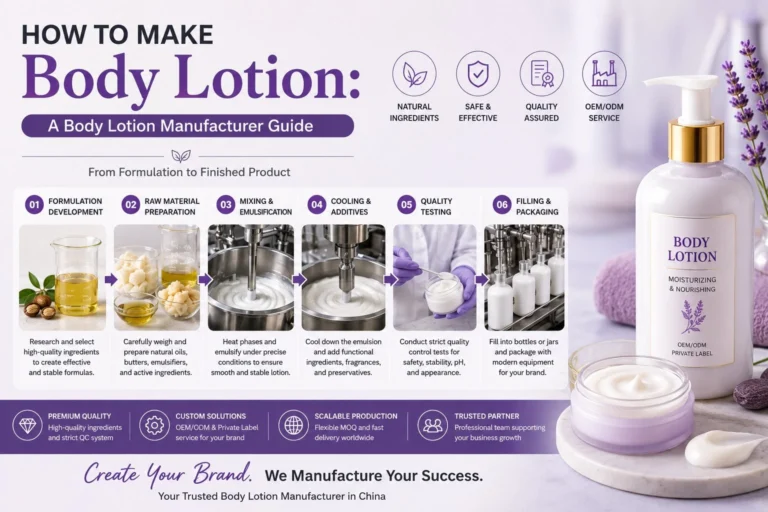
Get the feel right the first time. In-house emulsification R&D sits at the centre of the body lotion manufacturing service at Qianlan, prototyping multiple textures from one base. Talk to our team to match a texture to your brand promise and validate it with real panel testing.