









Most sourcing decisions are made from a PDF. A supplier sends a company profile, a few photos of stainless steel tanks, a certificate scan, and a price list — and the buyer signs. The problem is that none of those documents tell you the two things that actually determine whether your project succeeds: what the equipment can physically do, and how much of that capacity is already committed to somebody else.
This guide walks through a body lotion plant the way an experienced sourcing manager walks through it: station by station, asking what each machine implies about your minimum order, your unit cost, your lead time and your risk. Whether you visit in person or run a video tour, these are the things worth looking at.
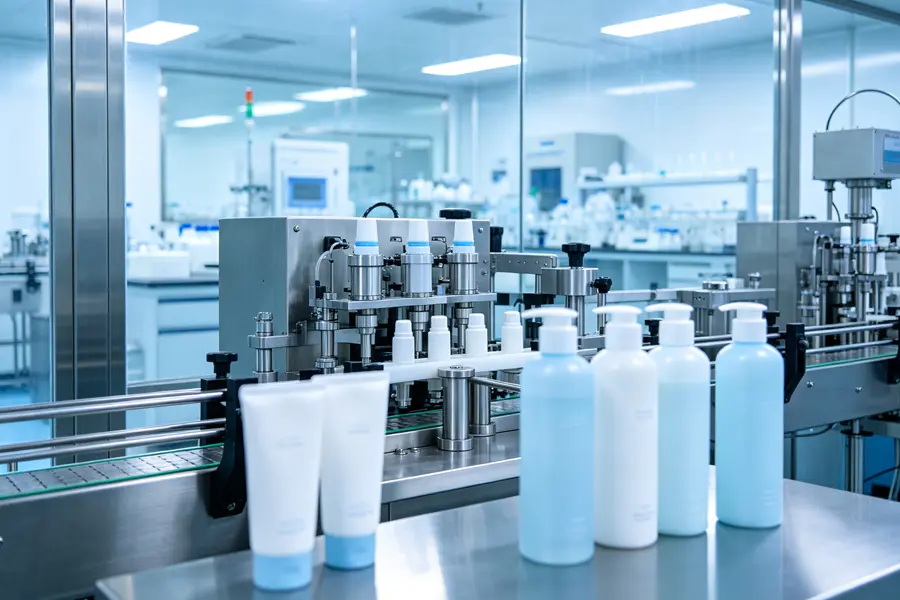
Why the plant, not the pitch, sets your commercial terms
Emulsion manufacturing is capital equipment work. A vacuum emulsifying mixer is not something a trading office keeps in a spare room, and a filling line that can run a 300 ml pump bottle at 40 units per minute is not something you improvise. That is exactly why the equipment list is such a reliable signal — it is expensive to fake and easy to verify.
When we quote projects at Qianlan, the numbers come out of the vessel schedule and the filling line calendar, not out of a wish. If you understand the same constraints, you stop negotiating against fiction. Before you go further, it is worth confirming that the party you are talking to owns the assets at all — the difference between a factory and a middleman is covered in our guide to telling a real factory from a trading company.
The line, station by station
1. Raw material warehouse and dispensing
Look for segregated zones: quarantine, released, rejected. Every drum and bag should carry a batch number and a status label, and there should be a weighing room with a calibrated scale and a printout trail. If actives, fragrances and preservatives sit on the same open shelf as packaging cartons, batch traceability is theatre.
Ask to see one raw material and follow it backwards: supplier CoA, incoming inspection record, release signature, dispensing record for a specific batch. Two minutes of that tells you more than an hour of slideshow.
2. Water treatment
Lotion is typically 65–80% water, so water is your largest single ingredient. You want reverse osmosis or deionisation, a loop that circulates rather than a dead-leg storage tank, UV or ozone sanitisation, and conductivity and microbial logs. Purified water systems are the most common quiet failure point behind contamination recalls.
3. Emulsification
This is the heart of the plant. A proper vacuum emulsifying mixer has a jacketed main vessel with steam heating and chilled-water cooling, a separate oil phase pot and water phase pot, a homogeniser head plus a slow scraper agitator, and vacuum for de-aeration. Vacuum matters: air whipped into an emulsion produces the tiny bubbles and grey cast that make a cream look cheap, and it accelerates oxidation.
Note the vessel sizes on the nameplate. Typical sets are 100 L, 300 L, 500 L, 1,000 L and 2,000 L. Those numbers are not trivia — they are the arithmetic behind your MOQ.
4. Storage and transfer
After the batch passes lab release, bulk goes into holding tanks or drums. Look for how bulk gets to the filler: a closed pump-and-pipe transfer is hygienic; open buckets and a ladle are not. Ask how long bulk may sit before filling, and what re-test applies if it exceeds that window.
5. Filling, capping and labelling
Piston or servo fillers handle viscous lotion; peristaltic fillers suit thin liquids. What you want to record is nozzle count, rated speed, and how the machine handles your specific closure. Disc-top caps, lotion pumps, airless bottles and tubes each need different tooling and different torque settings. A plant with a single semi-automatic filler can absolutely produce good lotion — it just cannot produce 80,000 units in ten days.
Also ask about changeover time. A line that needs four hours of cleaning and format change between products will not welcome your 2,000-unit trial order into a busy week.
6. Coding, cartoning and finished goods
Check that batch code and expiry date are printed inline, not stickered by hand. Confirm that finished goods are palletised off the floor, and that there is a physical quarantine area for product awaiting release. Ask to see a retention sample cabinet — a plant that keeps retained samples per batch for the full shelf life is a plant that expects to be audited.
7. The QC laboratory
Minimum credible set: pH meter, viscometer, incubators for microbial plating, oven and freezer for accelerated and freeze-thaw cycling, and a balance. If micro testing is outsourced, that is acceptable — ask for the third-party lab name and a recent report. The tests that matter and the reports you should demand are detailed in our breakdown of stability testing and shelf life evidence.
Batch size arithmetic: where your MOQ actually comes from
Suppliers rarely explain MOQ, so buyers assume it is a negotiating position. Usually it is geometry. A vacuum emulsifier runs correctly only between roughly 40% and 90% of nominal volume — below that the homogeniser head is not properly submerged and shear is inconsistent.
| Vessel | Practical batch | ≈ units at 200 ml | ≈ units at 500 ml |
|---|---|---|---|
| 100 L | 40–90 L | 200–450 | 80–180 |
| 300 L | 120–270 L | 600–1,350 | 240–540 |
| 500 L | 200–450 L | 1,000–2,250 | 400–900 |
| 1,000 L | 400–900 L | 2,000–4,500 | 800–1,800 |
So when a factory quotes a 3,000-unit MOQ on a 200 ml bottle, that is often a 500 L or 1,000 L vessel talking. The useful question is not “can you halve the MOQ” but “what is your smallest vessel, and what does a batch on it cost per unit?” A small pilot vessel is one of the most valuable assets a partner can offer a new brand, because it lets you launch on real production equipment instead of a lab beaker.
The other half of the equation is fixed cost spread over batch size — set-up, cleaning validation, QC release and documentation do not shrink when your order does. That is why per-unit pricing moves so sharply at low volumes; the mechanics are laid out in our unit cost breakdown.
Capacity: the question almost nobody asks
Rated speed is marketing. Effective output is what you get after changeover, cleaning, breaks and rejects — often 55–75% of nameplate. Do this calculation in front of your supplier:
- Filling speed in units per minute for your pack format, not their fastest one
- Shift pattern — one shift of eight hours, or two?
- Realistic uptime — apply 65% unless they can show OEE data
- Committed capacity — how much of next month is already sold?
Worked example: 30 units per minute × 480 minutes × 65% ≈ 9,360 units per shift. A 50,000-unit order therefore needs roughly six production days on that line — plus compounding, plus lab release, plus packaging arrival. If a supplier promises 50,000 units in nine days total, either they have two lines or they are guessing. Cross-check the promise against the sequence in our article on the OEM production timeline.
A ten-minute plant tour checklist
- Ask to see the batch record for a product made last week — not a template, an executed one with signatures.
- Photograph vessel nameplates: capacity, model, year.
- Check the calibration sticker date on one scale and one pH meter.
- Look at the floor and the ceiling. Peeling paint above an open vessel is a contamination path.
- Confirm gowning: hair covers, dedicated shoes, hand wash before the filling room.
- Ask what happens to product that fails release. A plant with no rejection history has no functioning QC.
- Ask which lines are theirs and which work is subcontracted. Subcontracting is normal; hiding it is not.
- Look at the pest control log and the cleaning log for the current week.
Running a video tour instead? Ask them to walk the route in one continuous take rather than sending clips, and ask them to zoom in on nameplates and calibration labels while you watch. Static photos are the easiest thing in the world to borrow from someone else’s factory.
Red flags worth walking away from
- No vacuum on the emulsifier for a premium cream project
- Bulk transferred in open containers across an unclassified corridor
- Batch codes applied by hand-sticker after packing
- No retained samples, or retention only for “important” customers
- Refusal to show any executed batch record on confidentiality grounds — redacting a customer name is reasonable, refusing the entire document is not
- An equipment list that cannot produce the MOQ they just quoted
How this feeds your negotiation
Once you know the vessel sizes and the line speed, three things become negotiable in a way they were not before. You can propose a first batch matched to the smallest vessel instead of arguing about MOQ in the abstract. You can request a production window rather than a vague lead time, because you know how many shifts your order consumes. And you can tie payment milestones to physical events — bulk release, filling start, pre-shipment inspection — rather than to calendar dates.
That last point is where equipment knowledge turns into leverage. When your inspection clause references a specific line and a specific batch record, both sides know exactly what is being checked; see our guidance on in-process checks and AQL inspection for how to word it.
Frequently asked questions
Do I need to visit in person?
Not always. A live video walkthrough plus an executed batch record, a calibration list and an equipment inventory gets you most of the way. For orders above roughly USD 50,000, or for regulated claims, a third-party audit is cheaper than a failed shipment.
Can a small factory be better than a large one?
Frequently, yes. Large plants optimise for long runs and treat small orders as an interruption. A mid-size operation with a 100 L pilot vessel and a flexible filler will often give a launching brand better attention, faster sampling and lower trial cost.
What if the factory subcontracts filling?
Common and acceptable, provided it is disclosed, the subcontractor is named in your agreement, and QC responsibility stays with your contracted party. What you must avoid is discovering the arrangement after a defect appears and nobody will own it.
Which single document reveals the most?
The executed batch manufacturing record. It shows real weights, real times, real deviations and real signatures. Certificates prove a system existed on audit day; a batch record proves the system runs on ordinary Tuesdays.
Bringing it together
Equipment is the honest part of a supplier relationship. Vessels have nameplates, fillers have rated speeds, calibration stickers have dates. Read those and you can predict your MOQ, sanity-check your lead time and understand why your unit price is what it is — before a contract exists.
Qianlan runs its own emulsification and filling lines in Guangzhou, from 100 L pilot batches through to full production runs, and we are happy to walk buyers through the line on video before any commitment. If you are comparing options, start with our body lotion manufacturing capabilities and send us the pack format and volume you have in mind — we will tell you which vessel and which line your project would actually run on.