








What MOQ Really Means
MOQ — minimum order quantity — is the smallest production run a factory will accept for one SKU. In OEM cosmetics it is not an arbitrary number; it is driven by raw-material supplier minimums, filling-line setup time, and the cost of qualifying a batch. For body lotion, typical MOQs run 1,000 to 5,000 units per SKU, with stock bases at the low end and fully custom formulas at the high end. Understanding where the number comes from helps you negotiate it instead of simply accepting it. A transparent body lotion manufacturer will break the MOQ down for you rather than quoting a single opaque figure.
Why MOQs Exist
- Raw material pack sizes. Specialty actives and fragrances are sold in supplier minimums; below a certain volume the factory cannot use what it opens.
- Line setup and cleanup. Each changeover on a filling line costs labor and lost output, so small runs are inefficient.
- Batch qualification. Microbial and stability checks are run per batch; very small batches make that cost per unit balloon.
- Print and mold minimums. Custom bottles, pumps, and printed cartons carry their own supplier MOQs, often 3,000–10,000 pieces.
Typical MOQ by Product Type
| Product path | Typical MOQ (units) | Notes |
|---|---|---|
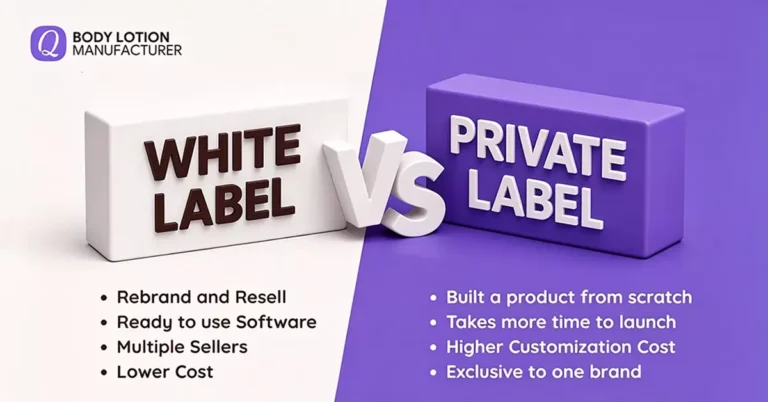
| White label, stock pack | 1,000–2,000 | Lowest; uses existing bottle |
| Private label, stock base | 2,000–3,000 | Custom label, maybe custom scent |
| Private label, custom pack | 3,000–5,000 | New bottle/mold minimums apply |
| Custom OEM formula | 3,000–5,000+ | Specialty raws drive volume up |
MOQ vs Unit Cost — The Trade-off
Higher volumes almost always lower your per-unit cost, but they raise your cash tied up in inventory. A rough pattern: moving from a 2,000-unit run to a 5,000-unit run might cut unit cost by 10–25%, but it more than doubles the cash you commit and the stock you must sell. The right MOQ is the one your sales forecast supports, not the one that yields the cheapest unit. If you cannot confidently sell 5,000 units in your planning window, the “savings” are an illusion paid for in dead stock.
How MOQ Interacts With Formulation
Your choice between a stock and a custom formula directly changes the minimum. Stock bases avoid specialty raw minimums, so they sit at the low end. Custom work often needs a unique emulsion and actives bought in supplier packs, pushing MOQ up. The custom formulation vs stock formula decision is therefore also an inventory decision — choose custom only when demand justifies the larger first order.
Negotiating a Lower MOQ
If a factory’s MOQ strains your budget, try these levers before walking away:
- Use stock packaging. Dropping a custom bottle is the fastest way to cut a 5,000-unit MOQ to 2,000.
- Agree to a volume ramp. Commit to 10,000 units across three shipments and many factories will accept a 2,000-unit first run.
- Share a production slot. Some manufacturers batch similar bases and split fills; ask if this is possible.
- Accept a setup fee. Paying a small tooling or line-setup charge can buy a lower unit minimum.
- Choose a simpler format. A tube or stock jar is cheaper to minimum than a custom airless pump.
Our deeper guide on how to lower the MOQ for body lotion walks through each tactic with example numbers.
MOQ Red Flags
- No MOQ at all on custom work. A factory claiming it will custom-develop and fill 200 units is almost certainly cutting testing or hiding costs.
- MOQ that jumps after sampling. If the quoted minimum changes between brief and contract, demand the reason in writing.
- Hidden per-SKU minimums. Confirm the MOQ applies per SKU, not per total order, or a 3-SKU launch can quietly become 9,000 units.
Planning Inventory Around MOQ
Once you know the MOQ, model it against your sell-through. A simple approach: estimate monthly units sold from any pre-launch interest (waitlist, ad clicks, comparable products), multiply by your acceptable stock cover (e.g., 2 months), and compare to the MOQ. If MOQ exceeds that, either negotiate down, choose a leaner packaging path, or delay launch until demand is clearer. This discipline protects the cash flow that kills more indie brands than bad formulas do.
MOQ and the Manufacturer You Choose
Different factories have different comfort zones. A large contract manufacturer may enforce 5,000-unit minimums; a flexible private-label specialist may start at 1,000. Your optimal partner depends on your stage, which is why how to choose a body lotion manufacturer in China and MOQ strategy should be decided together, not separately.
Sample MOQ Math for a Startup
Suppose your target retail is USD 18, target COGS USD 4, and you forecast 600 units/month after launch. A 2-month cover is 1,200 units — within a 1,000–2,000 stock-base MOQ. But a custom 5,000-unit MOQ would mean 8 months of cover and USD 20,000 tied up before you know the product sells. In this case the stock-base path is clearly safer. Revisit the custom path only after the 600/month forecast is real.
Making MOQ Work For You
Treat MOQ as a planning input, not a barrier. Start at the lowest defensible volume, prove demand, then use volume commitments to earn lower unit pricing on reorders. The manufacturers worth partnering with will help you stage this growth rather than pushing the biggest first order.
MOQ for Packaging Components
Even when the emulsion MOQ is low, the packaging often sets the real floor. Custom bottles and pumps carry supplier minimums of 3,000–10,000 pieces, and printed cartons may require 2,000–5,000. If you want a 1,500-unit first run, you must either accept stock packaging or buy the component minimum and carry the surplus into later orders. This is why “low MOQ” claims can be misleading — always ask whether the minimum applies to the formula, the bottle, or the printed carton, and which you are actually committing to.
A Reorder Cadence That Protects Cash
Plan reorders against real sell-through, not optimism. A workable rule: reorder when stock covers about 6 weeks of forecast sales, and order enough to arrive before you hit 2 weeks of cover. This smooths cash flow and avoids both stockouts and a warehouse full of slow product. Your manufacturer’s re-order lead time (often 45–60 days) sets the trigger point, so confirm it in writing and build it into your planning calendar.
Case Study: Right-Sizing a First Order
A founder forecasting 400 units/month chose stock packaging and a 2,000-unit MOQ (5 months of cover) at USD 1.70/unit, total USD 3,400. Sales beat forecast at 600/month, so the run lasted 3.3 months and the reorder of 3,000 units earned USD 1.55/unit. By staging the second order on proven data, she avoided either over-committing at the start or stocking out during growth. The MOQ was a planning input, not a trap.
MOQ and Working-Capital Reality
Many promising brands fail not from weak products but from tying up cash in inventory they cannot move. Before accepting any MOQ, calculate the worst case: if you sell half the forecast, how long does the remaining stock take to clear, and what is the carrying cost? If the answer threatens payroll or ad spend, the MOQ is too high — negotiate down or choose a leaner packaging path. A flexible manufacturer audit will reveal which partners genuinely support small first orders.
A Negotiation Email That Works
When you ask for a lower MOQ, vague requests get vague refusals. Try a concrete, partnership-framed email: “We forecast 8,000 units in year one but need a 2,000-unit first run to validate. If we commit to a 6,000-unit reorder within 90 days of delivery, can you accept the lower start? We would use your stock bottle to keep setup minimal.” This gives the factory a volume story and a concrete plan, which is far more likely to unlock flexibility than “can you do 2,000?”
MOQ Glossary for Founders
- Formula MOQ: minimum emulsion the line will run.
- Component MOQ: minimum bottles/pumps/cartons from the supplier.
- Print MOQ: minimum for custom-printed artwork.
- Batch MOQ: smallest economically testable batch.
Knowing these terms lets you pinpoint exactly which minimum is blocking you and negotiate around it precisely.
Want a starting order that fits your budget? Qianlan is a GMP-certified body lotion manufacturer offering low-MOQ private label and OEM with flexible volume ramps. Contact our team for a quotation tuned to your real forecast.