








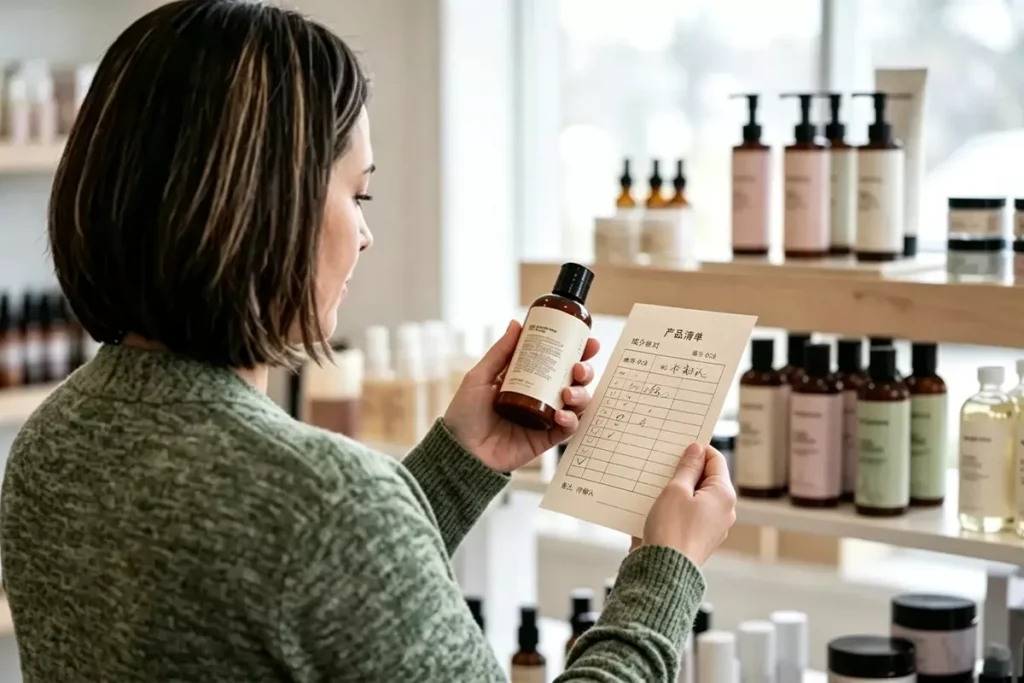
Most private label buyers never look at the one document that decides whether their product succeeds: the formula. They pick a body lotion manufacturer, approve a sample by feel, and move on. Then a competitor launches a near-identical lotion at half the actives, a retailer asks for the ingredient rationale, or a stability study fails because nobody understood what was actually in the bottle. Knowing how to read a body lotion formula is the single skill that turns you from a label-buyer into a brand owner who can brief, challenge, and protect a product. This guide walks through INCI naming, concentration order, the actives that matter, and the red flags a buyer should never ignore.
1. What an INCI List Actually Is
INCI (International Nomenclature of Cosmetic Ingredients) is the standardized ingredient name printed on every cosmetic label and used in the formula sheet your manufacturer works from. It is not marketing copy. It is a controlled vocabulary: “Aqua” means water, “Glycerin” means glycerin, “Butyrospermum Parkii (Shea) Butter” means shea butter. When you read a formula, you are reading the same language the chemist, the regulator, and the retailer all use. If your manufacturer hands you a formula with only trade names and no INCI, that is the first warning sign – you cannot verify, register, or defend a product you cannot name.
2. Ingredients Are Listed in Descending Concentration
The single most useful rule: in both the INCI label and a full formula, ingredients appear in descending order of concentration, down to 1%, after which order is generally unrestricted. That means the first five entries are the bulk of your lotion – usually water, then a humectant, then emollients and emulsifiers. If “water” is first (it almost always is), everything else is a small fraction of the total. A buyer who skims to the middle of the list to find the “star” active has already misread the product: the headline ingredient is rarely the largest one. Judge a lotion by its top five, then by whether the actives further down are present at a level that can actually do something.
3. Decoding Names: INCI vs Trade vs Botanical Latin
The same material shows up three ways. A supplier’s trade name (“Lipidure,” “Ceramide NP”) tells you nothing until you map it to INCI. Botanical extracts use Latin binomials – “Aloe Barbadensis Leaf Juice” is aloe. Plant-derived and synthetic versions of the same molecule share one INCI name, so INCI alone does not tell you the source; if “natural” is part of your claim, you must ask the manufacturer for the source specification separately. Our breakdown of natural versus synthetic body lotion ingredients explains exactly where the two diverge and where they do not, and why the INCI line alone will not settle the argument.
4. Concentrations Are Rarely Printed – and That Is the Point
A consumer label stops at INCI order; a real formula sheet shows percentages. When a manufacturer is reluctant to share exact percentages, ask for functional ranges instead: “0.5-1.0% hyaluronic acid” is enough to judge performance without handing over the full proprietary recipe. What you want to confirm is that each active sits inside its effective window. An ingredient listed at 0.01% is a label claim, not a benefit. Reading a formula well means reading the gap between “present” and “present at a useful level.”
5. The Actives That Actually Matter in Body Lotion
For a rinse-off or leave-on body lotion, a small set of categories does the work. Humectants (glycerin, sodium hyaluronate, urea, panthenol) pull water into the skin – glycerin is the workhorse, and our piece on hyaluronic acid in body lotion covers why molecular weight changes the feel. Emollients (shea butter, squalane, esters) soften and smooth. Occlusives (dimethicone, petrolatum, plant waxes) slow water loss. A credible moisturizing lotion needs at least one of each; a formula heavy only on occlusives will feel greasy, one heavy only on humectants will feel thin. The balance is the formula, and you can read it from the top five plus the emollient block.
6. Preservative Systems and Why They Are Non-Negotiable
A water-based lotion is a microbial growth medium. The preservative system (often a blend: phenoxyethanol, caprylyl glycol, ethylhexylglycerin, or traditional parabens) is what keeps the bottle safe for its shelf life. When reading a formula, confirm there is a preservative and that it is appropriate for the pH and the claimed shelf life. “Preservative-free” in a water-containing lotion is either a mislabel or a stability and safety risk. This is where the formula connects directly to testing – a preservative claim must be backed by challenge testing, which is covered in our guide to body lotion stability testing and shelf life.
7. Fragrance, Allergens and Labeling
Fragrance appears as “Parfum” or a specific compound and may carry allergen disclosure obligations in some markets (the EU 26 allergens). If your positioning is fragrance-free or sensitive-skin, the formula should show no parfum and no essential-oil constituents. Read the fragrance line carefully: “natural fragrance” is still fragrance and still an allergen vector. For a clean or baby-adult crossover line, the absence of certain compounds is as important as the presence of actives, and you should be able to verify it from the sheet.
8. Matching Claims to What the Formula Supports
Every claim must trace to an ingredient present at a functional level. “Deep 24-hour moisturization” requires humectants plus occlusives at meaningful percentages and, ideally, instrumental proof. “Brightening” needs a named, permitted active – not a vague botanical blend. When a formula hides its actives inside a “proprietary complex,” ask for the complex’s full breakdown; you cannot substantiate a claim on an ingredient you are not allowed to see. The discipline of claim-to-ingredient mapping is what keeps a brand out of regulatory trouble and ahead of competitors who over-claim.
9. Red Flags When Reading a Formula
Watch for these: (1) no INCI names, only trade names; (2) the hero active buried below 1% with no effective window stated; (3) a “complex” or “blend” that dodges disclosure of its active component; (4) a preservative system that does not match the water content or pH; (5) two near-identical quotes with wildly different prices but the same top-five actives – the difference is usually in the actives further down, which is exactly where you should look. A manufacturer who welcomes these questions is one you can build a brand with.
10. Using the Formula to Brief Your Manufacturer
Once you can read a formula, your brief improves. Instead of “make it moisturizing,” you write: “glycerin at 3-5%, shea butter at 2%, sodium hyaluronate at 0.5-1.0%, preservative system validated to 24 months, fragrance-free.” That brief is testable, quotable, and defensible. It also lets you compare manufacturers on substance rather than on sales language, because you are now comparing formulas, not promises. Pair this with our guide to customizing your private label body lotion to turn the read into a specification.
11. Where a Buyer Should Get Help
You do not need a chemistry degree to read a formula usefully – you need the rules above and a manufacturer willing to walk the sheet with you. Qianlan’s Guangzhou body lotion facility develops against full, transparent INCI specifications, with the stability, safety, and claim-substantiation documentation that turns a formula into a launchable, defensible product. If you are evaluating a first formula or challenging a supplier’s quote, get in touch and we will read it with you – line by line – so the bottle you ship is the bottle you intended to build.