









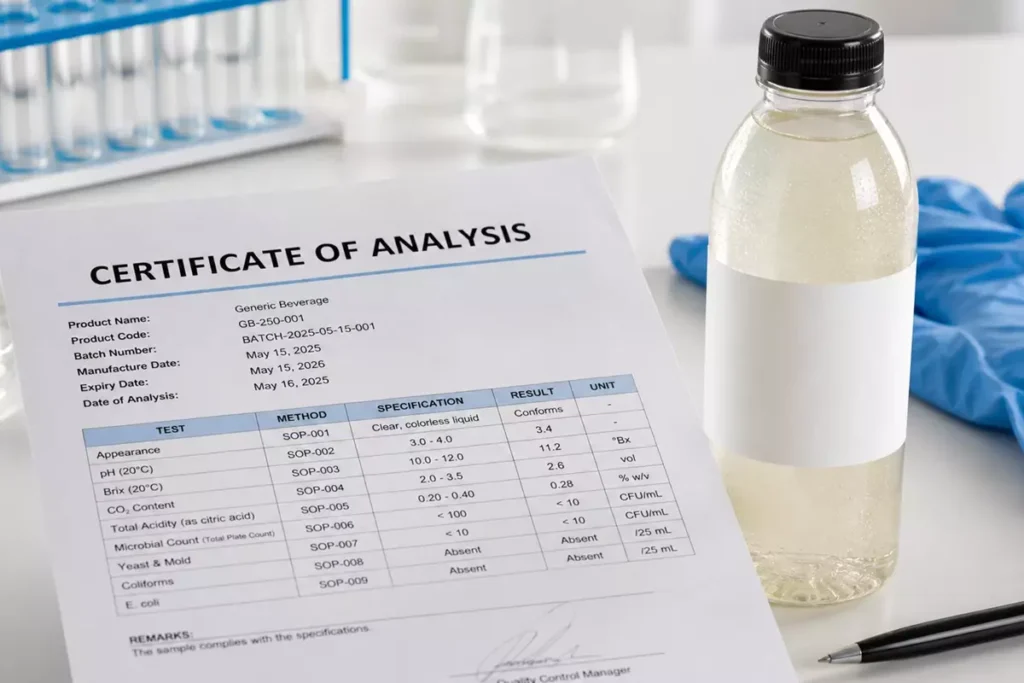
When you source a private label or contract-manufactured moisturizer, the most important document you receive after a batch is produced is not the invoice and not the marketing copy. It is the Certificate of Analysis, or COA. A professional body lotion manufacturer issues a COA for every finished batch, and knowing how to read it separates buyers who launch safely from buyers who discover a problem only after a customer complains. This guide explains what a COA contains, how to interpret each section, and the red flags that should stop a shipment.
What a COA Is and Why Your Body Lotion Manufacturer Issues One
A Certificate of Analysis is a batch-specific document in which the body lotion manufacturer’s quality control team declares that a specific lot met its written specifications. It is generated after production and laboratory testing, not before. Unlike a general marketing claim, a COA ties results to a tangible batch number you can trace back to raw materials, equipment, and operators.
You should treat the COA as the single source of truth for whether the product you approved in sampling is the product you are about to ship to customers. If your contract says the formula must have a pH of 5.5 and the COA shows 7.8, you have a documented, provable discrepancy before the goods ever leave the factory.
The Core Sections of a Body Lotion COA
Most reputable body lotion manufacturers structure their COA the same way. Learn these sections and you can read any supplier’s document quickly.
1. Identity and Batch Information
This header block confirms what the sample actually is: product name, batch or lot number, production date, expiry or best-before date, quantity tested, and the specification version used. Always confirm the batch number on the COA matches the physical drums or bottles you receive. A COA for lot A cannot certify lot B.
2. Physical and Chemical Specifications
This is the heart of the document. Expect a table with at least these parameters:
- Appearance and color – usually a visual match against an approved standard or master sample.
- Odor – described and confirmed against the signed reference sample.
- pH – body lotions typically sit between 5.0 and 6.5; a value outside the agreed range can signal emulsion instability or irritation risk.
- Viscosity – measured on a defined spindle and speed; this protects your pump and filling line from clogging or leaking.
- Specific gravity or density – a quick check that the emulsion was made to the right ratio.
For a private label body lotion, these numbers should match the values established during your approved pilot. If viscosity drifts by 30 percent, the texture your customers loved will feel different in the next order.
3. Microbiological Limits
Cosmetics must be safe from harmful microbes. A proper COA reports total aerobic mesophilic count, yeast and mold, and specific pathogens such as Pseudomonas aeruginosa, Staphylococcus aureus, Escherichia coli, and Candida albicans. Reputable body lotion manufacturers test to recognized limits such as those in ISO 17516 or regional pharmacopeia standards, and the result should be “absent” or comfortably below the threshold.
This section is non-negotiable. A missing microbiology panel means the batch was never verified for safety, regardless of how good it looks.
4. Heavy Metals and Contaminants
Even naturally derived ingredients can carry trace lead, arsenic, cadmium, or mercury from soil or processing. A complete COA lists heavy metal results against regulatory ceilings (for example the limits referenced in FDA or EU frameworks). This matters for import markets: customs and retailers in the United States and European Union expect demonstrable compliance, and your stability testing and shelf life program is only credible if contaminant testing backs it up.
5. Preservative System and Challenge Test Reference
The COA may cite the preservative system used and reference a preservative efficacy test, also called a challenge test. The challenge test itself is usually a separate report, but the COA should at least confirm the preservative identity and concentration match the approved formula. Under-preserving a body lotion is one of the most common causes of in-market spoilage complaints.
6. Assay or Active Content
If your brief specifies an active ingredient at a claimed percentage – niacinamide, hyaluronic acid, ceramides, or a botanical extract – the COA should report the measured active content and confirm it falls within tolerance. This is what protects your marketing claims from being unsubstantiated.
How to Read the Specification Table
Every spec line has three columns: the specification (what was promised), the result (what was measured), and the tolerance or verdict (pass or fail). Read all three. A result of 6.2 against a specification of 5.5 to 6.0 is a borderline fail even if someone stamps “pass” on the document. Train your team to judge the numbers, not the stamp.
Pay special attention to anything marked “approximate” or “typical” rather than “tested.” Approximate values are useful for context but are not evidence the batch was measured. For critical safety parameters, insist on tested values.
Red Flags That Should Stop a Shipment
- No batch number or a batch number that does not match the physical goods.
- Missing microbiology panel – the single most dangerous omission.
- Hand-edited or unsigned COA with no QC responsible person named.
- Results outside tolerance but marked “pass” without an authorized deviation record.
- COA dated before production – a document created in advance cannot describe a real batch.
- Generic COA reused across multiple batches with identical values down to the decimal.
Any of these should trigger a hold and a conversation with your body lotion manufacturer before you pay the balance or release the goods.
COA Versus the Other Documents in Your File
Buyers often confuse the COA with other paperwork. Keep them straight:
- COA – batch-specific test results proving the lot met specs.
- Certificate of Compliance (CoC) – a broader statement that the product meets applicable regulations and your contract, often without per-batch test data.
- SDS or MSDS – safety data for handling and transport, not quality confirmation.
- Formula or INCI sheet – the ingredient declaration, which you should also verify through a separate formula review.
All four belong in your product file, but only the COA tells you the actual batch you received is good.
What to Demand Before You Sign
The time to define COA expectations is in the contract, not after a bad batch arrives. Before signing with a body lotion manufacturer, confirm in writing: which parameters are tested per batch, the accepted methods and limits, who performs the testing (in-house lab or third-party), turnaround time for the COA, and the procedure if a lot fails. Buyers who lock these terms early avoid the awkward moment when a supplier says “we do not normally test for that.”
How the COA Connects to Sampling and Stability
The COA does not stand alone. During development you should evaluate body lotion samples against the same parameters you later require on the COA, so your approved reference and your production spec are identical. Then your stability testing and shelf life program establishes how those parameters should hold over time. The COA is the per-batch proof that the line is still hitting the mark you validated.
A Practical Buyer’s COA Checklist
Before you release payment on any order, run this five-point check:
- Batch number on the COA matches the physical lot.
- Microbiology panel present and within limits.
- pH, viscosity, and appearance match your approved spec.
- Heavy metals and any claimed actives reported and compliant.
- Document is signed, dated after production, and issued by a named QC responsible person.
If all five pass, you have strong evidence the batch is launch-ready. If any one fails, stop and resolve it with your manufacturer before the goods reach customers.
Conclusion
Reading a Certificate of Analysis is a learnable skill that pays for itself on the very first shipment. The right body lotion manufacturer treats the COA as a quality promise, not a formality, and supplies complete, batch-specific, signed documentation every time. Build COA review into your standard incoming-inspection process, align the parameters with your sampling and stability work, and you protect your brand, your customers, and your reorder rate.