








The moment you sign a manufacturing agreement, the factory’s quality system becomes your quality system. If their sanitation slips, your batch is recalled. If their documentation is sloppy, your customs clearance stalls. If their certificate is fake, your retailer pulls your product. Verifying a body lotion manufacturer before you sign is not box-ticking — it is the single most defensive decision you make as a private label or custom brand. Buyers who skip it rarely discover the gap until a shipment is already in trouble.
This guide walks through which certificates actually matter for body lotion, what genuine GMP discipline looks like on the production floor, how to confirm a certificate is real, the red flags that should stop a deal, and a practical verification gate to run before you put pen to paper. Pair it with our master brief template and our contract-clause guide — certification is the foundation, and the brief and the contract are what you build on top of it.
Which Certificates Actually Matter for Body Lotion
Not every certificate a factory shows you is relevant, and some that matter are easy to overlook. For a private label body lotion brand, prioritize by where you sell and what you claim.
Cosmetics GMP (ISO 22776 / ISO 22716)
Good Manufacturing Practice is the baseline. Look for certification to ISO 22776 (the cosmetic-specific GMP standard) or ISO 22716 (cosmetic GMP guidelines). This is what tells you the factory controls contamination, traceability and batch consistency — the three things that decide whether two tubs from the same line are actually the same product. Without GMP, every batch is a small gamble.
FDA registration and MoCRA readiness (United States)
For the US market, the factory and the product fall under the FDA’s cosmetics framework, now reshaped by MoCRA (the Modernization of Cosmetics Regulation Act). You need a facility registered with the FDA and product listings maintained, plus access to the safety substantiation file. A serious body lotion export compliance posture means the factory can hand you the documentation your US distributor will demand, not a shrug.
EU CPNP and UK SCPN notifications
Selling into Europe or the UK requires the product to be filed in the CPNP (EU) or SCPN (UK) portal before it touches those shelves, backed by a Responsible Person and a safety assessment. Ask the manufacturer whether they support these notifications or expect you to arrange them — the answer tells you how export-ready they really are.
Vegan, cruelty-free and organic claims
If your brand promises “vegan,” “cruelty-free” or “organic,” the certificate must match the claim and the market. Leaping Bunny or PETA cruelty-free, Ecocert or COSMOS for natural/organic — each carries its own audit and renewal cycle. A claim without the certificate behind it is a regulatory liability, not a marketing line.
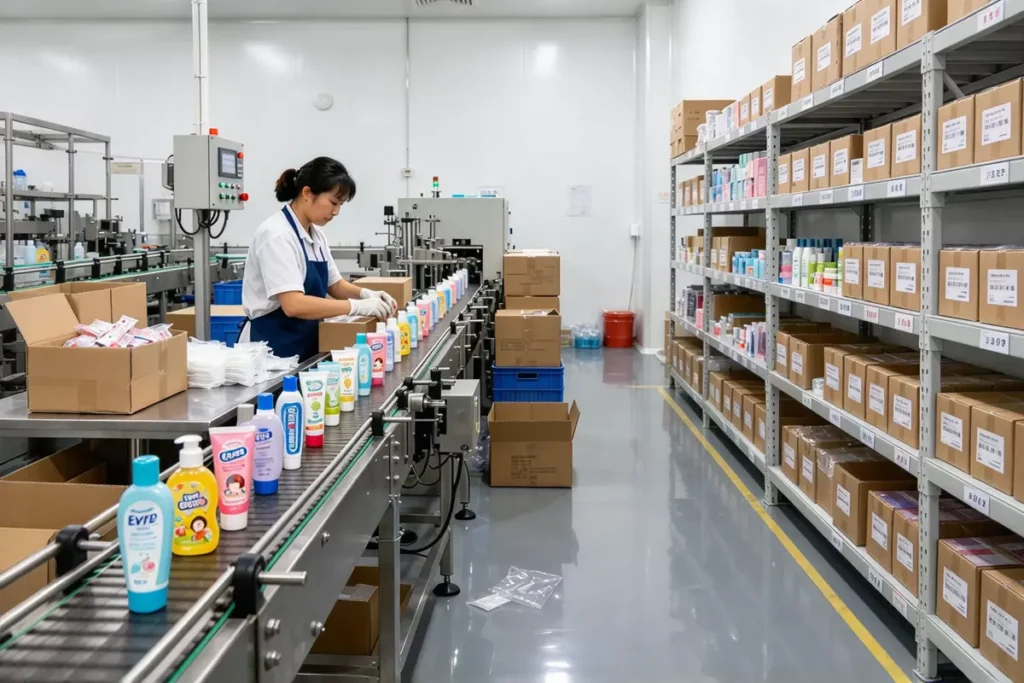
What GMP Discipline Looks Like on the Floor
A certificate on the wall is a starting point, not proof. The real signal is what you see and what the factory can show you on demand.
- Batch records. Every lot should have a manufacturing record: raw material lots used, weights, mixing times, temperatures, the operator, and the QC release. If the factory cannot produce a clean batch record for a product they made last month, walk away.
- Segregation and hygiene. Separate zones for raw material receipt, production, filling and packaging; controlled access; documented cleaning and sanitation of tanks and lines between products. Cross-contamination between a fragranced and a fragrance-free line is a classic failure mode.
- Traceability. From a finished tub’s lot number you should be able to trace back to the exact raw material batches and their supplier certificates. This is what makes a recall targeted instead of total.
- Trained personnel and documented procedures. GMP is a habit, not a poster. Ask to see the standard operating procedures and the training log; a factory that cannot show them is running on memory.
How to Verify a Certificate Is Real
Forgery is common enough that “I saw a PDF” is not verification. Close the loop with four steps.
1. Get the original, not a screenshot
Request the certificate as a signed PDF from the issuing body, not a photo the factory took of a framed document. Note the certificate number, the issuing organization, the scope (which products or sites it covers) and the expiry date.
2. Check the issuer independently
Most reputable certification bodies let you verify a certificate number on their public portal. A five-minute check turns a plausible-looking file into either proof or a red flag. If the issuer has no verification channel, treat the certificate with suspicion.
3. Confirm the scope and dates
A GMP certificate for “food” does not cover cosmetics. A certificate that expired two months ago is not current. A scope that lists a different legal entity than the factory you are contracting is a mismatch worth questioning.
4. Tie documentation to the shipment
Build certificate validity into your acceptance criteria: each shipment should arrive with a current Certificate of Analysis and evidence that the underlying GMP certificate was in force at production time. This is the same discipline we apply when we brief a custom formulation — the document is the rule, not the hope.
Red Flags That Should Stop a Deal
Some signals are loud enough to end the conversation before it costs you money.
- No batch records on request. If the factory hesitates to show how they track a lot, they are not tracking it.
- Refusal of a factory tour or a third-party audit. A genuine GMP operation welcomes verification. “Trade secret” is not a valid answer to “can we see the line?”
- Expired or mismatched certificates. Covered above — never contract against a lapsed or out-of-scope document.
- No INCI disclosure or formula transparency. You cannot substantiate claims, file CPNP, or manage allergens without the full ingredient list. A manufacturer that will not disclose INCI is a compliance dead end.
- Vague answers on contamination control. If they cannot describe how they clean a line between a fragranced and a fragrance-free batch, assume they do not.
A Verification Gate for Your Workflow
Run this checklist before signing anything, and do not advance a supplier that fails more than one item:
- Current GMP / ISO 22776 certificate, scope and dates confirmed with the issuer.
- Market-specific files available: FDA facility registration and MoCRA substantiation for the US; CPNP/SCPN support for EU/UK.
- Sample batch record provided and legible.
- Factory tour or independent audit accepted.
- Full INCI disclosure and allergen handling documented.
- Certificate of Analysis committed per shipment.
Three passes and you have a supplier you can defend. Two failures and you have your answer.
How Verification Connects to Your Contract
Certification is the foundation; the agreement is what enforces it. The contract clauses you negotiate should mirror the verification gate: warranties that certificates remain current, audit rights, recall responsibilities, and IP ownership of your custom formula. A certificate a factory lets lapse next quarter is only a problem if your contract gives you recourse when it happens. Verification before signing and enforcement after signing are the same control viewed from two ends.
Frequently Asked Questions
Do I need GMP if I am only doing a small private label run?
Yes. GMP is what protects a 500-unit run exactly as much as a 50,000-unit run — contamination and inconsistency do not scale politely. The only thing a smaller run changes is which certificate tiers are worth the cost, not whether GMP matters.
Can the factory handle my US and EU filings, or do I arrange them?
It varies. Some manufacturers offer turnkey CPNP/SCPN and FDA support; others hand you the dossier and expect you to file. Clarify this before signing, because the answer changes who owns the compliance clock and who pays if a filing is late.
What if a certificate is real but expires during my production cycle?
That is exactly why your contract should require current certificates at the time of each production run, not just at signing. A lapsed certificate mid-contract is a breach you can act on only if you wrote it in.
Is a “GMP compliant” statement enough without a certificate?
No. Self-declared compliance is not verification. Insist on an independent certificate from a recognized body, confirmed through the issuer’s portal, before you rely on it.
Final Thought: Verify First, Manufacture With Confidence
A body lotion manufacturer worth partnering with will welcome verification, because their system is already disciplined and they know it protects both of you. Run the gate, confirm the documents through the issuer, mirror the findings in your contract, and you remove the single largest source of downstream surprise. Our team manufactures private label and custom body lotions under current GMP for brands across the US and EU, and we are used to walking buyers through exactly this checklist — bring your questions to the contact page and we will verify alongside you.