








You have shortlisted a few suppliers, agreed on a brief, and now the first lab samples are on your desk. This is the single most important checkpoint in the entire private label journey. Approve a weak sample and you will multiply its flaws across ten thousand units; evaluate it properly and you lock in quality before a single production dollar is spent. Yet most first-time brand owners judge a body lotion sample the same way a consumer would — a quick sniff, a dab on the back of the hand, and a verdict within thirty seconds.
Professional buyers work differently. This guide walks you through the complete sample evaluation process used by experienced sourcing teams: what to test, how to test it, how many sampling rounds to expect, and when to sign off. If you are still comparing suppliers, start with our guide on how to choose a body lotion manufacturer in China, then come back here once samples start arriving.
Why Sample Evaluation Deserves More Than Five Minutes
A body lotion sample is a promise. It represents what the manufacturer believes it can reproduce at scale, batch after batch. When you approve it, that sample becomes the “golden standard” — the reference against which every future production batch is compared. If your golden standard was approved carelessly, you lose the contractual leverage to reject off-spec production later.
There is a second reason. Sample evaluation is your best window into how a body lotion manufacturer actually operates. A factory that ships samples with batch documentation, ingredient disclosure, and stability notes is showing you its quality culture. A factory that sends an unlabeled jar in a padded envelope is showing you something too.
Round One: The First Lab Sample
Expect the first sample 7–15 days after you confirm the development brief. When the parcel arrives, resist the urge to open the jar immediately. Work through these layers in order.
1. Documentation Check
Before touching the product, confirm what came with it:
- Formula version number — you will likely go through several iterations; version control prevents confusion later.
- INCI list — the full ingredient declaration in descending order. Cross-check it against your brief: did you ask for paraben-free? Vegan? Check now, not after launch.
- Basic spec sheet — pH, viscosity range, and appearance description. Serious manufacturers include these by default.
If none of this paperwork exists, request it before evaluating. You cannot judge whether a sample meets specification if no specification was written down.
2. Sensory Evaluation — Done Properly
Sensory testing is subjective, but you can make it systematic:
- Appearance: Check color under daylight, not office lighting. Look for uniformity — streaks, specks, or separation at the surface are red flags.
- Fragrance: Smell the lotion three times: in the jar, immediately after application, and 30 minutes later (the dry-down). Many fragrances that smell right in the jar turn flat or soapy on skin.
- Texture and pick-up: How does the lotion lift from the jar or dispense from the pump? A body lotion intended for pump bottles must flow; one for jars can be richer.
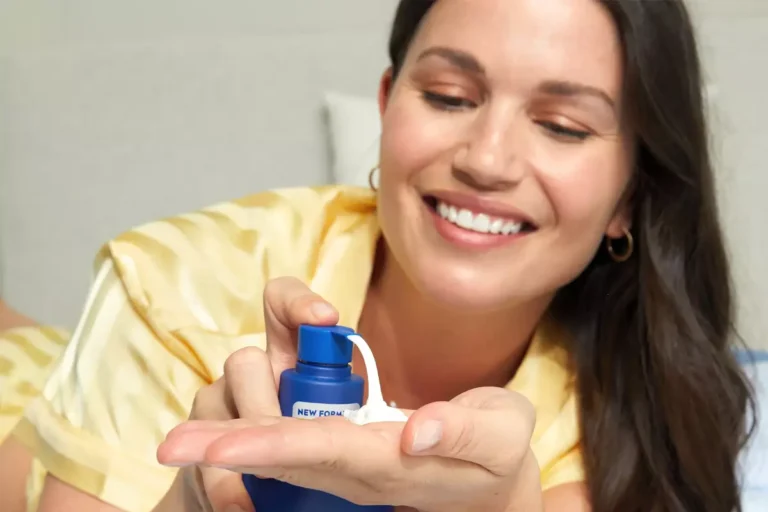
- Application: Apply a measured amount (roughly 2 mg per square centimeter — a pea-sized drop for a forearm) and note spreadability, absorption time, and any stickiness at 5 and 15 minutes.
- After-feel: The sensation two hours later is what your customer remembers. Silky? Greasy? Gone entirely?
Recruit at least three to five testers with different skin types. Your own hands are not a representative panel, and fragrance perception varies dramatically between individuals.
3. Benchmark Comparison
Always evaluate against a benchmark — either the market product you asked the factory to match, or your previous best sample. Side-by-side, blind, on opposite forearms. Without a benchmark, your feedback degenerates into vague adjectives (“make it richer but lighter”) that formulators cannot act on.
Round Two: Giving Feedback That Formulators Can Use
The quality of your second sample depends almost entirely on the quality of your feedback on the first. Weak feedback: “It feels a bit cheap.” Strong feedback: “Absorption is too slow — still tacky at 15 minutes; benchmark product is dry at 8. Reduce the greasy after-feel but keep the fragrance identical.”
Structure feedback in a simple table covering appearance, fragrance, texture, absorption, after-feel, and packaging compatibility, with a keep/adjust verdict for each row. Most projects need two to three rounds of iteration; complex briefs with anhydrous textures or natural fragrance systems can take four or more. If you are debating whether to keep iterating on a custom formula or switch to an existing base, our comparison of custom formulation versus stock formulas explains the trade-offs in cost and timeline.
The Tests That Happen After You Say “I Like It”
Sensory approval is not final approval. Before mass production, insist on evidence of the following technical validations — reputable manufacturers run them as standard practice.
Stability Testing
Accelerated stability testing stores the lotion at elevated temperatures (typically 40–45°C) for 8–12 weeks to simulate one to two years of shelf life. It flags separation, color drift, fragrance degradation, and viscosity change. Ask for the report — a one-page summary with pass/fail criteria is enough. If a supplier claims stability testing is unnecessary, that is a disqualifying answer.
Compatibility Testing
Your lotion will live inside a specific bottle, pump, and cap for two years. Compatibility testing stores the formula in the actual packaging to detect interactions: pumps clogging, plastic panels warping, fragrance eating through liners, labels lifting. This is why you should finalize packaging in parallel with the formula, not after it.
Preservative Efficacy and Micro Testing
The challenge test (PET) confirms the preservative system can suppress bacteria, yeast, and mold introduced during consumer use. For exports to the US and EU markets this is effectively mandatory documentation. Alongside it, each production batch should carry a microbial test report.
Performance Claims
If your marketing will say “24-hour hydration” or “clinically proven,” the claim needs instrumented or clinical substantiation — corneometer measurements, trans-epidermal water loss data, or consumer perception studies. Decide which claims you need before production, because testing takes weeks and may require formula tweaks.
The Golden Sample Protocol
Once every test is passed, formalize the approval:
- Request three identical sealed samples from the approved batch. One stays with the manufacturer, one stays with you, one goes to your inspection company (if you use one).
- Sign and date the approval referencing the formula version number and spec sheet. Email is acceptable; a signed golden sample form is better.
- Agree on tolerances — acceptable ranges for pH, viscosity, color, and fragrance intensity. Production is chemistry, not photocopying; small variation is normal, and defining “small” in advance prevents disputes.
- Reference the golden sample in your purchase order. The PO should state that production must conform to golden sample v3.2 dated such-and-such, within agreed tolerances.
From this point, the golden sample becomes the anchor for pre-shipment inspection. When the first production batch is ready, compare a pulled sample against your retained golden sample before authorizing shipment — this step catches the vast majority of production drift. For a full view of what happens between sample approval and delivery, see our step-by-step OEM production timeline.
Common Sampling Mistakes to Avoid
- Approving from a single tester’s opinion. One person’s “perfect” is another’s “too greasy.” Use a small panel.
- Testing in the wrong climate. A lotion evaluated in an air-conditioned office in winter behaves differently on humid summer skin. If your market is tropical, test accordingly.
- Skipping the packaging test. The most common post-launch complaint traced back to sampling is pump and viscosity mismatch.
- Endless iteration. If round four is still far from the brief, the problem is usually the brief or the factory’s capability, not patience. Re-examine both rather than ordering round seven.
- Not retaining a sealed golden sample. Without your own retained reference, any future quality dispute becomes your word against theirs.
How Long Should the Whole Process Take?
A realistic schedule for a standard emulsion body lotion: first sample in 1–2 weeks, two feedback rounds adding 2–4 weeks, accelerated stability running 8–12 weeks in parallel with packaging procurement, and compatibility testing overlapping the same window. Plan on 3–4 months from brief to production authorization. Suppliers promising full validation in three weeks are skipping steps — usually the ones you cannot see.
Final Thoughts
Sample evaluation is where good sourcing decisions are made or unmade. Treat each round as structured data collection rather than a smell test, insist on stability, compatibility, and preservative efficacy evidence, and lock your approval into a golden sample protocol with defined tolerances. Do this once, rigorously, and every subsequent reorder becomes dramatically safer.
Ready to start sampling? Send us your brief or benchmark product, and our lab will turn around a first development sample with full documentation — INCI, spec sheet, and version control included — so your evaluation can start on a professional footing from day one.
Sampling is the opening stage of the custom body lotion manufacturing workflow at Qianlan, and the documentation standard stays identical from first development sample through to production.