








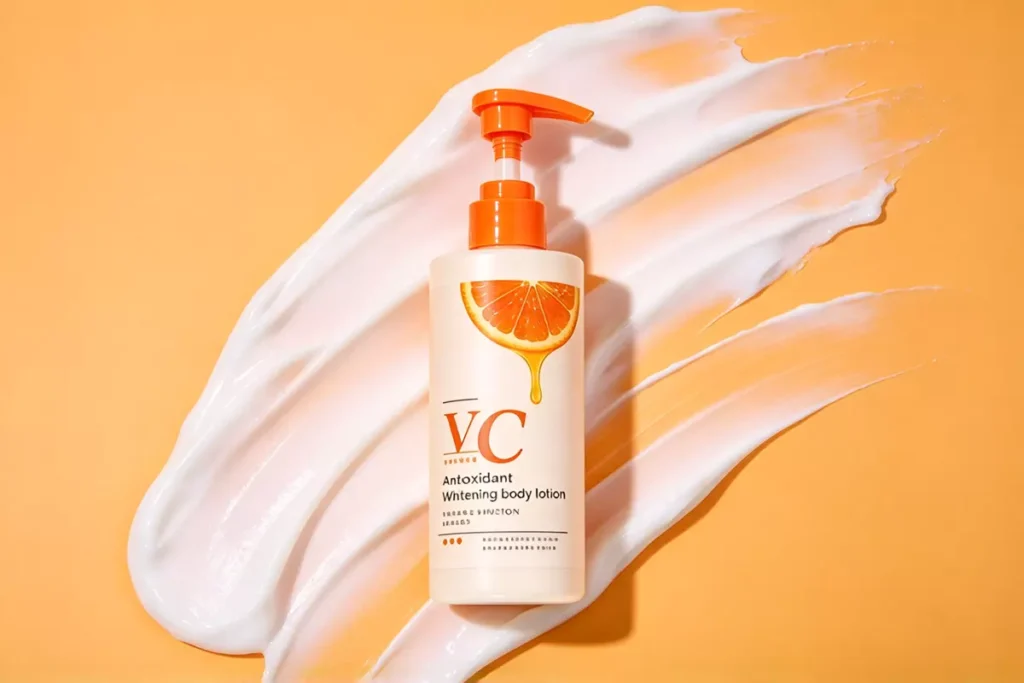
For brand owners moving into functional body care, a vitamin C body lotion is one of the most attractive product ideas on the shelf today. It promises the brightening and antioxidant credibility that buyers already associate with facial serums, extended across the larger body category. But vitamin C is also one of the more demanding actives to formulate at scale. The difference between a product that delights and one that oxidizes in the bottle comes down to how clearly you brief your body lotion manufacturer on derivative grade, concentration, pH and packaging.
This guide walks through exactly what a contract manufacturer needs from you to produce a stable, marketable vitamin C body lotion — and the formulation and production decisions that protect both efficacy and shelf life.
Why Vitamin C Works in Body Lotion
Vitamin C (ascorbic acid in its various forms) earns its place in a body formula for four reasons that buyers immediately understand. First, it is a proven brightening agent: it interferes with tyrosinase activity, which helps even out tone on commonly uneven areas such as elbows, knees and underarms. Second, it is a potent antioxidant that neutralizes free radicals generated by UV exposure and urban pollution, supporting the skin barrier between applications. Third, it layers naturally on top of the moisturization story every body lotion already tells — it pairs with humectants and emollients rather than replacing them. Fourth, it rides a genuine market trend: “glow” and “brightening” body care is one of the fastest-growing segments, and a credible vitamin C claim gives a new brand an easy story to merchandise.
Choosing the Right Vitamin C Derivative
Not all vitamin C is the same, and the derivative you choose dictates almost everything else about the formula. A professional body lotion manufacturer for custom formulation will walk you through these options:
- L-Ascorbic Acid (pure vitamin C). The most biologically active form, but also the least stable. It requires a low pH of roughly 3.0–3.5, is water-soluble, and oxidizes quickly when exposed to air, light or heat. In a body lotion it is risky unless the manufacturer tightly controls pH and packaging.
- Sodium Ascorbyl Phosphate (SAP). A salt form that is stable across a pH of 5.5–7.0, water-soluble, and far gentler on skin. For everyday body care it is one of the most practical choices.
- Magnesium Ascorbyl Phosphate (MAP). Similar to SAP in stability and pH tolerance, easy to work into standard emulsions, and a common pick for sensitive-skin positioning.
- Ascorbyl Glucoside and Ascorbyl Tetraisopalmitate. The latter is oil-soluble, extremely stable, and lipophilic, meaning it integrates well into emulsions and penetrates the lipid layer with less irritation — at a higher raw-material cost.
- Tetrahexyldecyl Ascorbate (THD Ascorbate). A highly stable, oil-soluble ester with strong penetration and minimal irritation, favored in premium brightening lines.
For a body lotion produced at volume, SAP, MAP and THD ascorbate tend to be the pragmatic winners. Pure L-ascorbic acid is reserved for brands that can justify the pH control, packaging investment and shorter shelf expectations. Tell your manufacturer which derivative matches your claim level and price tier — do not leave it open.
Concentration: How Much Is Enough
Typical use levels differ sharply by derivative. SAP and MAP are usually effective at 2–5%, THD ascorbate performs well at up to 3%, while pure L-ascorbic acid can run 5–15% in facial serums but is rarely pushed that high in body care because of stability and irritation. More is not automatically better: higher concentrations raise oxidation risk, deepen raw-material cost, and often deliver diminishing returns in perceived efficacy. Align your target concentration to the claim you intend to make, and make sure the claim is substantiated at that level.
pH and Formula Compatibility
pH is where many vitamin C body lotion projects stall. Pure L-ascorbic acid needs a pH of 3.0–3.5, which is incompatible with the gentle, skin-friendly emulsions buyers expect from body care and can destabilize the system or cause irritation. The phosphate and ester derivatives, by contrast, tolerate the 5.5–7.0 range that fits a comfortable body lotion. Your manufacturer must also consider the emulsion type — oil-in-water versus water-in-oil — and how the chosen vitamin C interacts with the preservative system. Pairing vitamin C with vitamin E (tocopherol) and ferulic acid is a well-established way to boost antioxidant synergy and stability, and a skilled formulator will propose it when the cost tier allows.
Protecting Stability: The Real Manufacturing Challenge
The headline risk with any vitamin C body lotion is oxidation. Vitamin C degrades on contact with oxygen, light and heat, and a degraded product turns yellow, loses potency and can develop off-notes. This is where your manufacturer’s process discipline matters more than the raw material spec sheet. Controls a competent plant will apply include adding the active under a low-oxygen environment or during the cool-down phase after emulsification, using chelators such as EDTA or sodium phytate, incorporating a small antioxidant such as tocopherol, and selecting airless or UV-opaque packaging with low water activity. None of these are visible on the label, but they decide whether the product still contains active vitamin C at month eighteen. This is precisely why a clear brief and a serious body lotion stability testing and shelf-life program are non-negotiable.
How to Brief Your Manufacturer: A Specification Checklist
Hand your body lotion manufacturer a one-page specification rather than a vague “make a vitamin C lotion,” and you will save weeks of rework. At minimum the brief should state:
- The target derivative and its exact INCI name.
- The use concentration (not just “add vitamin C”).
- The target pH window for the finished emulsion.
- The intended claims (brightening, antioxidant, glow) and the substantiation those claims require.
- The packaging format — airless pump versus jar, and whether it is UV-opaque.
- The target shelf life (commonly 24–36 months) and the climate zones the product must survive testing in.
- Your tolerance for color shift, since some derivatives can impart a slight yellow tint over time.
- Any companion actives (niacinamide, peptides) and whether they must be compatible in the same formula.
A transparent manufacturer will take that checklist and return a realistic formula, a stability protocol and a cost estimate. If a supplier pushes back on details, that resistance is a good sign they understand the chemistry.
Packaging and Shelf-Life Strategy
Packaging is not an afterthought for a vitamin C body lotion; it is part of the preservation system. Opaque, air-restrictive formats such as airless pumps or tubes dramatically slow oxidation compared with wide-mouth jars. Your brief should specify UV-protective or opaque materials and, where the brand allows, a “use within X months of opening” instruction. Packaging choice also has a direct cost implication, which is worth weighing against your target retail price — a topic your manufacturer can detail in a proper body lotion manufacturing cost breakdown.
Common Mistakes to Avoid
- Selecting pure L-ascorbic acid for a mass body lotion without the pH control and packaging to support it.
- Under-specifying packaging, then watching a clear jar oxidize on the shelf.
- Skipping stability testing across temperature and humidity cycles before launch.
- Making brightening claims the formula cannot substantiate.
- Choosing the cheapest derivative that yellows or irritates, then damaging the brand’s first impression.
From Brief to Production
The right sequence is brief, pilot batch, stability verification, then scale. A pilot run lets you confirm color, texture, scent and stability behavior at small volume before committing to a full order, and it surfaces any interaction between the vitamin C and your fragrance or preservative system early — when changes are cheap. At release and after accelerated storage, the manufacturer should assay actual vitamin C content so you know the labeled potency is real, not theoretical.
Frequently Asked Questions
Can a vitamin C body lotion lighten dark spots on the body?
It can gradually help even out tone on areas such as elbows and knees, but results are slower and subtler than a dedicated treatment serum, and buyer expectations should be set honestly.
Is vitamin C body lotion safe for sensitive skin?
The phosphate and ester derivatives are considerably gentler than pure L-ascorbic acid. A sensitive-skin brief with a milder derivative and buffered pH is usually well tolerated, but patch testing remains sensible.
How long does it last once opened?
With proper opaque, air-restrictive packaging, a 24–36 month shelf life is realistic; advise customers to use within 6–12 months of opening for best potency.
Does vitamin C conflict with other actives?
In a well-designed emulsion, vitamin C pairs well with vitamin E, ferulic acid and niacinamide. Avoid cramming multiple low-pH exfoliants into the same formula, as the combined acidity can destabilize the system.
Conclusion
A vitamin C body lotion is a strong addition to a functional body-care line, but its success is decided in the brief, not on the shelf. Choose a stable derivative suited to body-care pH, specify concentration and packaging with intent, and let your manufacturer prove stability before you scale. The brands that win this category are the ones that treat vitamin C as a chemistry problem solved upstream — not a claim added at the end. Explore our guide on how to read a body lotion formula and on briefing your body lotion manufacturer for custom formulation to take the next step, or reach out to our team to spec your product.